
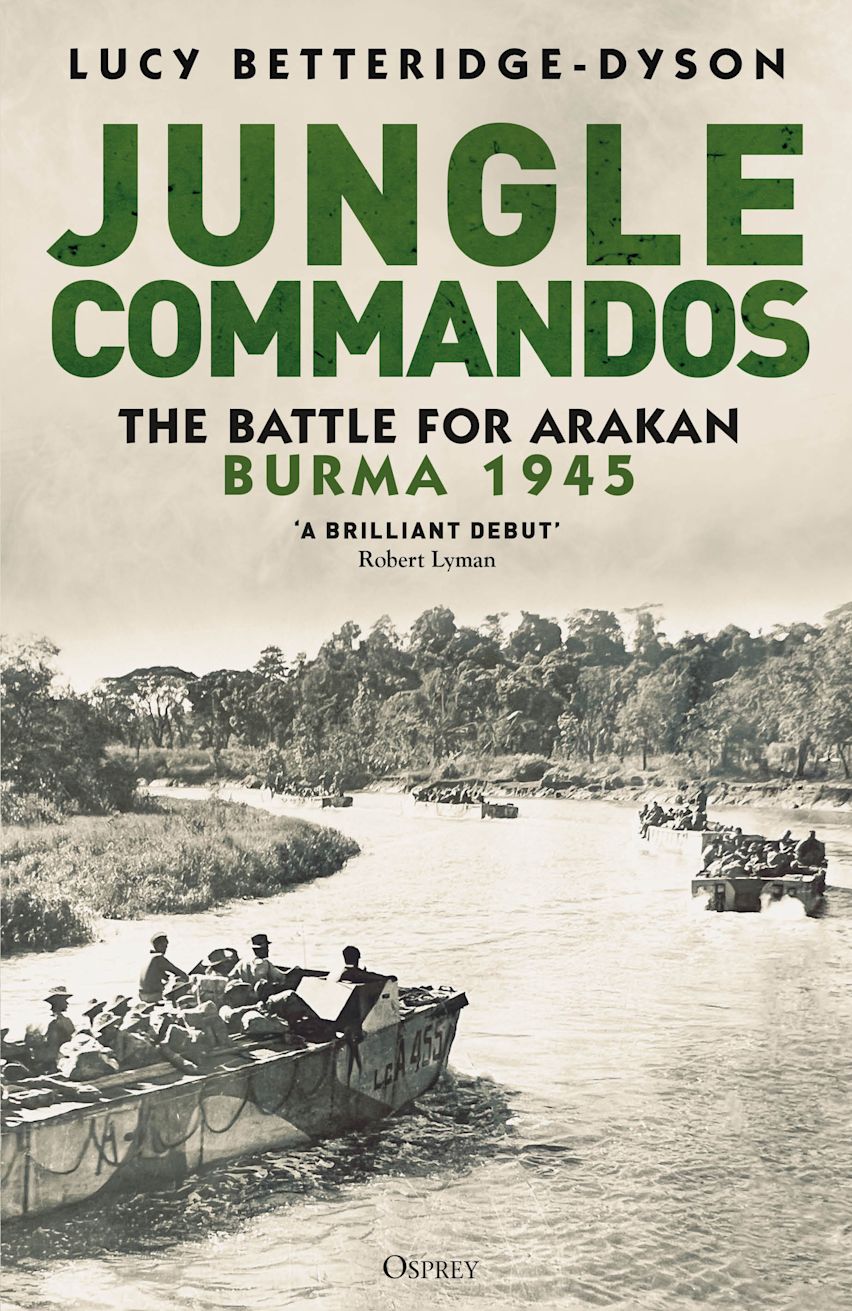
As the most experienced unit in the brigade, 1 Commando had been entrusted with the crucial task of leading the assault and securing Hill 170. Their first priority was to push inland as quickly as possible, since the swamp-like landing zone offered no refuge or anywhere to dig in. The landing craft were brought as close as possible to the shoreline before the men scrambled out into the thick, stagnant mud and tangled roots of the mangrove forests. ‘It was very hard on the back and the legs, but we got through eventually to the paddy fields and could see a hill in front of us,’ recalled Victor Ralph, one of the first to negotiate the shoreline.
The men waded through knee-deep sludge, pushing forward despite the unforgiving terrain. Ahead lay over a mile of flooded paddy fields, and beyond that, the southern slope of Hill 170 – just visible in the distance. With no cover to speak of, crossing the paddy was a tense business, the saturated ground making progress worryingly slow. Fortunately, there was little response from the Japanese so far, the landings having succeeded in producing complete tactical surprise, and the Commandos reached the southern side of the hill without issue. Immediately they began to dig in, recce the heights and secure as much of the hill as possible, ready for the inevitable counter-attack.
Meanwhile, 42 Royal Marine Commando, the second wave to land, had a different but equally vital role. Their task was to secure a bridgehead linking the landing zones through the swamp. It was an arduous and unpleasant task, leaving the men soaked and once again covered in mud. Attempts to keep kit dry were futile, though it did not stop the marines trying to save their most valuable items: ‘We had our haversacks [on], and it was mud and water up to our chests,’ recalled Robert West. ‘We had to take our big haversacks of and drag ’em. Most of us tried to save our cigarettes, but they got soaking wet of course!’ Despite the soggy smokes, 42 Royal Marine Commando had made good progress by the time the final two commando units came in to land. 5 Commando had been briefed to pass through the beachhead and proceed to Hill 170, whilst 44 Royal Marine Commando were to follow up the rear in reserve for the initial phase of the assault.
Whilst the infantry landings had been successful, efforts to get heavy equipment ashore were not going to plan. On the Z craft, Stuart Guild and his team were navigating the difficult waters, searching for the tributary where they had been ordered to land their guns. ‘This is your creek ahead, you know what to do with it!’ came a voice from the loudhailer of the LCH (Landing Craft Heavy) behind them. After lowering their dinghy and rowing ashore Guild quickly realised the proposed spot was unsuitable for siting their guns. ‘It was pure unadulterated mangrove swamp,’ he later wrote, ‘thick with mud, slippery mud-covered roots and practically nowhere to put a director, let alone stand.’ Unable to negotiate a path through the mangroves, the attempt was abandoned and the Z craft moved further upstream, eventually mooring with stem and stern tied to trees around 100 yards short of the main landing beach. Guild once again attempted to recce the area using the dinghy, but the narrow, mud-choked chaungs once again made it impossible to navigate. Determined to survey the land, he plunged into the swamp and trekked towards the edge of a paddy field on foot, cautiously peering over the bund. ‘There was no sign of any enemy but Japanese camouflage was second to none – so if there had been any I doubt if we could have seen them anyway.’ Still unsure of the security of their position, the small party returned to their dinghy, which they found stranded in the mud, the unpredictable tide having suddenly receded. Forced to drag the boat back through the chaung to the Z craft by half swimming and half wading, the crew arrived later and far more tired than planned. Sweating profusely and covered in thick, sticky mud, they set about preparing the guns for action.
The surprise of the attack and diversionary assault that had been put in by 74 Brigade from Kantha meant that by mid-afternoon the Japanese had still not responded to the landings, their primary defences all having been aimed at their northern flank. This was to change, however, when a targeted air strike was launched on Hill 170 ahead of 1 Commando’s push to the summit. Victor Ralph was clambering up the hill when he was stopped in his tracks as the sight of a young Burmese girl and her baby lying in a pool of blood emerged from the smoke: ‘The thought occurred to me: was it our shelling that did that, or when we were attacking, had the Japs mortared us? Then it occurred to me it didn’t matter very much. She was in her homeland and here were two foreign powers fighting, and she and her baby had died because of that.’
The strike on Hill 170 had finally shaken the Japanese into action and they soon began showering the beachhead with 75mm shells, as the mud-covered Stuart Guild and E Troop did their best to support the Commandos’ push up the hill: ‘Spasmodic shells splashed in the chaung, burst in the trees or thudded into the mud without exploding. I remember reading a ‘Dear John’ letter when a shelf splashed about 30 yards upstream from us. As the tide went out the Z craft tilted – so how effective we were I am not sure.’
The shelling continued throughout the afternoon, but with no sign of an immediate Japanese counter-attack, the landings continued with a focus on securing the beachhead and bringing as many supplies ashore as possible. By nightfall, 1 Commando had dug in along the ridge of Hill 170, with 5 Commando and Brigade HQ securing positions on the southern slope behind them.
You can read more in Jungle Commandos: The Battle for Arakan, Burma 1945 by Lucy Betteridge-Dyson.

Hill 170 sixty years after the battle (Author's Collection)
Comments
You must be logged in to comment on this post. Click here to log in.
Submit your comment