
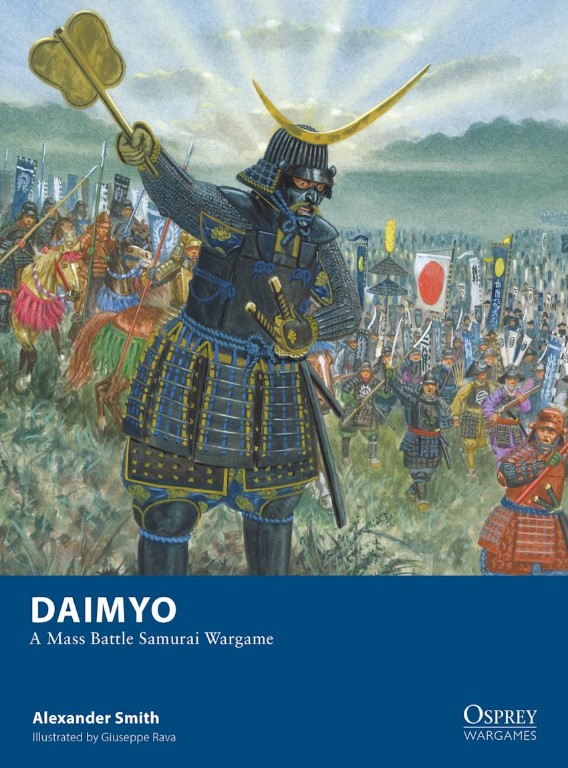
Daimyo is a set of fast-play, mass battle wargames rules set during Japan's Sengoku period. Today we’ll be looking at how you can organise and base your models ready for use with the system.
*************************************************************
Daimyo offers you the chance to command entire armies with a lightweight and flexible ruleset balancing historical accuracy with fun. A typical army commanded by a daimyo will include roughly 9–12 units though rules are scale agnostic, allowing you to represent battles between tens, hundreds, or even thousands of troops down at the smallest scale. Let's look at how you can equip and base your models ready for a game of Daimyo.
Equipping Your Units
From the simple yari spear to cutting edge teppo arquebuses, Daimyo features a diverse array of weapons and soldiers to wield them. In Daimyo a unit is defined as a distinct group of soldiers of the same type and armament. By the Sengoku Jidai period, daimyo generally organised their troops by the types of weapons they carried though formations were not always entirely homogenous. For example, a unit of Teppo Ashigaru will function on the tabletop as a missile unit equipped with firearms. However, a samurai or two, leading in the front rank as officers or a few more poorly equipped Ashigaru armed with bows scattered within the unit would not be out of place. This gives you greater scope in your modelling to add character and variety within your units, without altering their battlefield role and ability.
Unit Strength
Units come in two sizes: small and large. The size and type of unit determine the unit strength. Unit strength is used to track the fighting readiness of units in Daimyo. Units start at a predetermined unit strength that drops as they take casualties. This lowers the number of attack dice they receive, and the number of morale dice they roll.
Players may opt to match the unit strength with the number of models in their unit, which makes determining unit strength easy at a glance. However, at smaller scales players will likely have many more models in their unit than unit strength listed below.

As units clash in combat, they inevitably lose unit strength due to casualties. Unit strength can be tracked by removing models from the unit though if you do not wish to individually base your models or are playing at a smaller scale with many more models than the unit strength value, you can instead place tokens or die next to the unit to indicate how much strength has been lost. For clarity, both players should track the amount of strength lost from a unit in the same way.
Unit Basing
Whether you want you prefer multi-model or individual basing, this ruleset strives to be flexible with its basing conventions. So long as the footprint for units are roughly equivalent between players, it won’t greatly affect the balance of the game. Commanders during this period generally favoured long thin formations for their troops. As such, units are arranged in two equal ranks. The recommended unit footprints are as follows:

Below are some examples of possible basing schemes for your units in Daimyo.

*************************************************************
Daimyo is available July & is available to pre-order now.
Find all the gaming resources you need as free downloads here.

Comments
You must be logged in to comment on this post. Click here to log in.
Submit your comment