
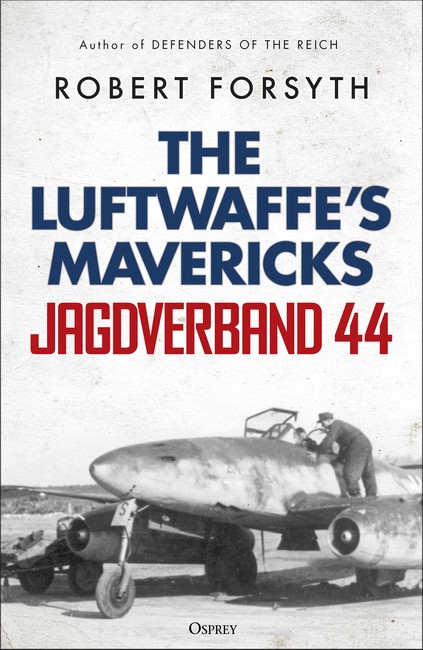
When Osprey Publishing asked me if I would write a piece for the blog about my latest book, The Luftwaffe’s Mavericks – Jagdverband 44, I must admit I had to think carefully about how exactly I would approach the task. The fact is that one way or another, the short-lived Me 262 squadron that was JV 44 has been in my life for nearly fifty years. How did that come about?
Although revised and expanded with fresh information, the new book is published thirty years since my first account of this intriguing unit. To mark the ‘anniversary’, I felt this would be the platform to look back on how research has changed since I first put pen to paper (figuratively) some thirty-two years ago.
Perhaps a brief historical overview first: being a child of the 1960s and a teenager of the 1970s, I was weened, like so many, on a diet of war movies, war documentaries, war comics, war memoirs, books about the war and plastic kits of war machines. Strangely, in 2026, it seems little has changed! ‘The war’ was still very much around us and I had two uncles who had been at Dunkirk and, respectively, in North Africa and Italy, and the Far East. Having been packed off to boarding school, I happened to share a room with a Canadian pal who returned after the holidays clutching a copy of Secret Treaties, an album by the American rock band, Blue Öyster Cult. Before I even listened to the first track, what caught my eye was the sleeve art. The front was adorned with a sketch of the band posed around the sleek, shark-like airframe of what I recognised to be a Messerschmitt Me 262. I have no idea why the bandmembers elected to use the aircraft as a backdrop, but there was another sketch on the rear cover, a view from above, showing that long nose, the nosewheel beneath it, the teardrop canopy, Willi Messerschmitt’s elegantly designed swept-back wings, the tall tail fin and the beautifully proportioned nacelles for the jet engines – yes, jet engines in World War II.
That was probably the start of it. The Blue Öyster Cult had stamped the Me 262 into my impressionable consciousness and so began my deeper interest in the world’s first operational jet interceptor.
It was around this time too, that I read a memoir (1955 edition) written by the well-known Luftwaffe fighter ace, Adolf Galland, published in English as The First and the Last. It was a book, regarded by many, perhaps rightly so, as self-serving, which nevertheless sold many thousands of copies, in many editions, in many languages. My copy was in a dustjacket depicting a pair of stylised Me 262s, an aircraft of which Galland was a champion and which, from 1943, he believed would provide Germany’s aerial salvation.
The moment I read that book, however, I became intrigued by Galland’s account of the squadron that he established towards the end of the war when he had been dismissed as the commanding general of the Luftwaffe’s fighter arm and the fact that he had managed, like some ‘Pied Piper’ character of old German folklore, to lure several renowned and highly experienced, but disillusioned fighter aces to join him. In the immediate post-war years, something of a myth grew up around his recollections and those of others to create ‘The Squadron of Aces’. Of course, in 2026, the story is well known, and some aviation and military history buffs will dismiss it as old hat – but that is my point. When I read The First and the Last, I was about seventeen years old which would have made it 1976/77 and it was a very different time then.
Just a few years later, in the early 1980s, after I had read Johannes Steinhoff’s (quite) revealing memoir The Last Chance – The Pilot’s Plot Against Göring 1944 – 1945, I decided to have a crack at discovering more. I needed to go to Germany and talk to the surviving pilots of JV 44. In those days, someone researching wartime history was fortunate in as much as many veterans were still with us. However, being a Brit trying to obtain the wartime collections of German veterans meant that reservation or reluctance on the part of many former pilots, distance, and language all became barriers. Furthermore, as a young man in my twenties on a middling salary, flying to Germany, booking reasonable accommodation, train travel, buses and taxis, and basic sustenance thrown in, was an expensive prospect – especially when set against the alternative of a relaxing holiday with my girlfriend! Not to mention, the time taken off my holiday allowance for something that was, potentially a risky wild goose chase.
But, after many letters and much time waiting for responses, in 1990 I finally did it, setting up an intensive itinerary from one end of Germany to the other, and in doing so, I met several interesting and intriguing characters. My trip was almost thwarted when the IRA fired a mortar bomb at Heathrow airport. On more than one occasion, I was asked by two former Luftwaffe fighter aces for my opinion of Margaret Thatcher; I travelled to a remote village on the Baltic coast, visited wonderful houses overlooking vineyards on the Rhine, and took a taxi ride deep into a very dark and lonely forest in central Germany. I was stuffed with beer, coffee and cake – Kaffee und Kuchen.
Other veterans of JV 44 lived in North and South America and one of them never quite seemed to grasp that there was a seven-hour time difference between his home in western Canada and mine in southern England. Or perhaps he did. In any case, he had a habit of calling me at 3 a.m. to send me a fax, which set off the bedroom phone, much to my wife’s annoyance. In those days, there was no internet and no email.
The details of these incidents are in the Introduction to my book.
After tracking down as many former JV 44 veterans as I could, I then did the same thing for the crews of the USAAF B-26 Marauder squadrons who came up against JV 44’s Me 262s over Bavaria in April 1945. This resulted in an avalanche of fascinating letters arriving in the post from the United States, all containing unique first-hand accounts of air combat, which I hope have served to bring my book alive. I was also very fortunate to meet two influential individuals in England, one a retired USAF general, who were visiting with their fellow veterans on a trip to their former airfields at Stansted Mountfitchet and Earles Colne. They opened doors for me.
Over the past few years, I have realised how fortunate I was to have met and/or corresponded with those Luftwaffe and USAAF veterans in Germany and North America, for they have all gone now.
The second main channel of assistance in writing the book came from a small number of friends and colleagues who shared a similar interest to mine. In many cases their knowledge, understanding and expertise was much greater than my own, but regardless, the generosity, warm friendship and encouragement that I encountered was wonderful. We even formed a group and would visit the Imperial War Museum and National Archives here in the UK to research en masse. Again – no internet, no email, so we photocopied and posted letters to one another for mutual assistance.
In 2026, the research ‘landscape’ has changed considerably. For an author setting out to write on World War II subjects, the option to seek oral history has all but gone. This means that now research is, in effect, ‘limited’ to documentary sources.
Equally, the means of interacting with fellow researchers over the internet and via email means fast and free communication and obtaining results with no boundaries of distance. That is a wonderful thing, but I remain delighted that I had that opportunity to engage with veterans at first hand, that I have visited archives in Europe and North America, touched the papers that represents real history, and that I have forged personal friendships of 40 years and more rather than relying solely on faceless internet contact.
I am grateful to Osprey Publishing for allowing me to recount the story of Jagdverband 44 once again, with fresh eyes and for a different world.
Comments
You must be logged in to comment on this post. Click here to log in.
Submit your comment