
I was flattered and excited when I was told that Osprey had enquired about me authoring a book on Mosquito operations in the Far East for their Combat Aircraft series. I have always liked and respected the series since it was launched during the mid-1990s. The format has clearly stood the test of time. Like most historians and authors, I place a high value on how my work is presented. My first concern was whether I could work within the series’ established structure. I was delighted when it quickly became clear to me that the concept behind the Combat Aircraft series had been carefully constructed so that it could be applied almost universally but with in-built flexibility to cope with different roles, events, operational theatres and, importantly, authors. Tony Holmes, the Combat Aircraft series editor, made contact with me and I was hooked!
Full disclosure: I am biased. I love the Mosquito. I think that it is the most innovative, beautiful, flexible and awesome combat aircraft from the Second World War, but I know that I am not alone. I have always been particularly passionate about Mosquito operations in the Far East. This is because my father, Flight Sergeant ‘Benny’ Walsh, was a young Mosquito intruder pilot who flew with three squadrons in the theatre, Nos. 27, 82 and 45 Squadrons. Understanding what he experienced was my primary motivation behind my first book, Mosquito Intruder Pilots. Already an experienced intruder pilot in Europe, Benny flew one of the first de Havilland Mosquito FB.VIs to India from the UK in September 1943. That ferry journey in itself was eventful, with two engine failures and a couple of hours of single-engine flying. Once in India, my father helped convert 27 Squadron aircrew from the Beaufighter to the Mosquito and then flew some operations with 27 Squadron. However, since they had been continuously flying operationally for fifteen months, instead of completing the conversion, the squadron was stood down from operations. The Mosquitos together with some aircrew with Mosquito experience, including my father, were transferred to 45 Squadron. This squadron had a very different challenge, because they had been flying the American-built single engine Vultee Vengeance dive-bomber and were tasked with converting to a day and night low-level intruder and strike role in the British-built twin-engine Mosquito. My father flew forty operations with 45 Squadron. My passion for the Mosquito came from my childhood, since my father always spoke extremely fondly of the excitement and pleasure in flying the Mosquito, although he rarely mentioned operations. Most of the people who flew the Mosquito were of the same opinion as my father. Flying Officer Walter ‘Wal’ McLellan was one of the Australian pilots who had been with 45 Squadron since it was re-formed. Wal’s views on the conversion to the Mosquito were very clear; ‘a pilot’s dream compared to the obsolete Bristol Blenheims and the brute Vengeance dive bombers we had flown before.’ Ensuring that the achievements of the aircrew and groundcrew from nos. 27, 45, 47, 82 and 110 Squadrons were not forgotten was the motivation behind my second book, Mosquito Intruders – Target Burma.
The brief I was given by Tony was to cover all the operational Mosquito units in the Far East during the Second World War. The Combat Aircraft series brief would expand my research to cover the photoreconnaissance units. These were as specialist as the intruders in the way that they operated, and I knew that they had also demonstrated the capabilities of the PR Mosquitos by breaking new records for distance. It also enabled me to include an iconic flight, on 16 June 1945. Squadron Leader Cliff Andrews with fellow New Zealander Flight Lieutenant Jack Irvine took off from Alipore in a 684 Squadron PR.XVI, NS787 ‘M’. It was equipped with 100-gallon auxiliary underwing tanks, on a flight authorised as ‘a high-altitude fuel consumption test on a course from Calcutta to Darjeeling and return.’ In reality, they intended to be the first to photograph the summit of Mount Everest. On return, Cliff reported, ‘We made a wide circuit and had a splendid view of the southern slopes of the South Peak, Lhotse and the saddle between Lhotse and Everest. I was so dazzled with this scene of beauty that I think I just kept on circling.’ They photographed the peak for over twenty minutes. Andrews continued, ‘As a final gesture we decided to fly as close to the very summit as possible … as we approached, we closed in, and when the summit flashed past just above our wing tip it was only about thirty feet away. As we crossed the Northeast Ridge, we experienced a terrific wallop from a down draught which took us quite unawares, but we were fortunately well clear. At this sign of impatience from the greatest of all mountains, we bade farewell.’
The environment in the Far East and the fact that the intruders frequently maximised their accuracy through dive bombing created a perfect storm to demonstrate the weaknesses of the Mosquito. I have recently become the custodian of the logbook, photograph album and maps from one of my father’s friends in 45 Squadron. My family and I feel very honoured to have been asked by his son to look after them. Before he was posted to 45 Squadron, Flight Sergeant Alf Pridmore had lost his pilot, Canadian Flight Lieutenant Richard ‘Dick’ Campbell, when he was killed during an air test on 10 October 1944. As Alf explained, ‘Dick was asked to test a Mossie whose exhaust shrouds had been burnt out leaving no shield to the exhaust flames. Dick did not want to fly this, anticipating a fire risk, but the engineering officer wanted to fly in a Mossie and persuaded Dick it was safe and to let him go in my place. I was watching from the ground and saw the wing break off at about 8,000ft and spin into the wild scrub away from the airfield. Subsequent investigation revealed blood and feathers at the point of impact where a kite hawk (a large vulture-like bird) had broken the plywood skin causing the main spar to separate at the joint.’ The aircraft loss was one of the early failures which demonstrated that the structure of the Mosquito and its build were not well suited to the high temperatures, humidity and operational roles in the Far East. By December 1944, after the Mosquitos had been grounded several times, the aircrew recognised the risks they were taking. As Flying Officer Ronald ‘Babe’ Wambeek of 82 Squadron said, ‘From that time on, whenever the ground crew hammered on the wooden cockpit hatch to make it fast before start up, it was difficult to avoid the impression that they were hammering down a coffin lid!’ These truly were brave young men. The structural weakness of the Mosquito and the hostile environment did not dull their love for the aircraft and flying it to its limits.
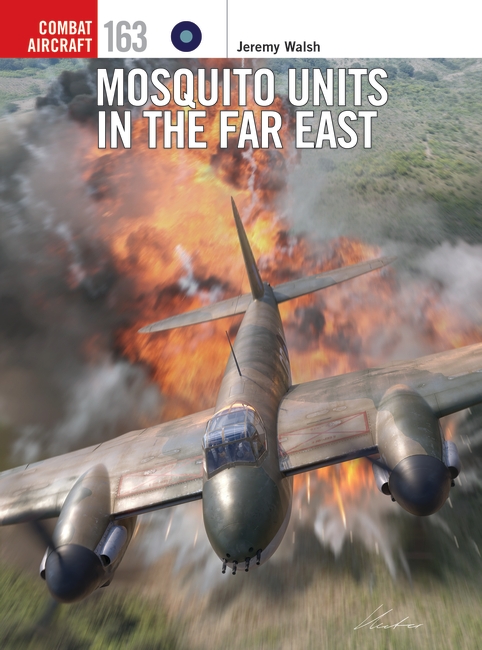
The final factor that excited me about this book was the opportunity to work for the first time with illustrators, both of whom are hugely talented. The cover image was created by Gareth Hector, who has enjoyed a successful career in the world of computer animation. Digitally painting and art directing, he has worked on high profile projects such as Call of Duty, Warhammer, Doctor Who and Halo. Gareth has worked on numerous Osprey aviation titles over the past 25 years, producing some of the finest artwork ever to grace the covers of these books. The cover image is based on a single sentence. ‘At least when we flew out of the inferno we knew that it had been a success.’ These were my father’s words when he recalled his low-level bombing operation on a fuel dump at Fort Dufferin in Mandalay on 26 January 1945. It was Benny’s 48th operation and when he and his navigator, ‘Ossie’, arrived back at RAF Khumbhirgram they found the tailfin of one of their 500-lb bombs embedded in the fuselage of their Mosquito! Janusz Światłoń, who is based in Poland, is the artist who created the highly detailed profiles of the Mosquitos in the book. He has produced artwork for a variety of British and European aviation publications for many years and has undertaken commissions for Osprey for more than a decade. I proposed various aircraft as subjects for the profiles, covering all of the featured squadrons. I have to say that I was impressed with both the detail in his profiles and his knowledge of Second World War aircraft in general.
I feel privileged to have worked with Tony, Gareth and Janusz. I hope that my passion about and love for the Mosquito comes through in Mosquito Units in the Far East.
Comments
You must be logged in to comment on this post. Click here to log in.
Submit your comment