
When people think of the decisive campaigns of 1944, they usually picture Normandy. The D-Day landings and the brutal fighting through the hedgerows have become enduring symbols of the beginning of Nazi Germany's defeat.
Yet while Allied forces battled inland from the beaches of France, an even greater military catastrophe was unfolding nearly 2,000 kilometres away. On the Eastern Front, the Red Army launched Operation Bagration, an offensive that would destroy Germany's strongest field formation and fundamentally reshape the course of World War II.
At dawn on 22 June 1944 – exactly three years after the launch of Operation Barbarossa – the Red Army struck along a broad front across Belarus. The timing was deliberate. What had begun as Hitler's greatest triumph would now become one of his greatest disasters.
A masterclass in operational warfare
At the start of the summer of 1944, Heeresgruppe Mitte appeared secure. Its defensive line stretched across the forests, rivers and marshes of Belarus, anchored by a chain of heavily fortified strongpoints. German commanders believed the sector was relatively safe, expecting the next major Soviet offensive to fall further south.
The Soviet Stavka had other plans. Concealed behind an elaborate deception campaign, four Fronts, thousands of tanks and artillery pieces, and immense logistical resources were assembled for a massive assault. When the offensive opened, the Germans were caught completely off balance.
Bagration showcased the Red Army at the height of its wartime effectiveness. Gone were the costly, improvised attacks of 1941 and 1942. In their place was a sophisticated doctrine of operational warfare that combined overwhelming artillery fire, deep armoured penetrations, close coordination between combat arms and large-scale encirclements designed to destroy entire enemy formations rather than merely force them back.
The first domino
One of the offensive's first objectives was Vitebsk, a fortress city anchoring the northern flank of Heeresgruppe Mitte. Hitler ordered it to be held at all costs, convinced it was essential to the German defensive system. Instead, it became a trap. Rather than battering directly into the city, Soviet commanders bypassed it, severing roads, railways and communications while armoured spearheads drove deep into the German rear. Within days, the defenders were surrounded.
By 27 June, the Vitebsk pocket had collapsed. Thousands of German troops were killed or captured, several divisions ceased to exist, and a massive gap opened in the German front. Vitebsk was the first domino. Its fall triggered the rapid collapse of the entire defensive system of Heeresgruppe Mitte.

German strongpoints along the woodland front line in the Vitebsk region were constructed from earth, local stone and timber. While not as effective as concrete, they were quite efficient against enemy patrols, but they could not withstand larger forces. (Author’s collection)
The destruction of Heeresgruppe Mitte
As German commanders struggled to restore order, Soviet forces surged westwards with astonishing speed. Their next objective was Minsk, the capital of Belarus and one of the Eastern Front's most important communications hubs. Capturing the city mattered, but Soviet planners aimed for something much larger: the encirclement and destruction of the German forces retreating towards it.
Fast-moving tank formations swept around German positions while infantry armies closed the trap. On 3 July 1944, Soviet troops entered Minsk. East of the city, tens of thousands of German soldiers were caught in a vast pocket as Soviet forces tightened the ring. The destruction was catastrophic. Entire corps headquarters disappeared, veteran divisions were wiped from the order of battle, and the remnants of Army Group Centre were left shattered and incapable of mounting an effective defence.
For Germany, the loss of Minsk was a disaster comparable in scale to Stalingrad. For the Soviet Union, it marked one of the greatest victories of the war and opened the road into Lithuania and Poland.

A column of German trucks, cars and horse-drawn wagons on the road from Minsk to Vilnius. During their retreat, the Germans were constantly under attack from Soviet ground-attack aircraft. (Author's collection)
The Gates of the Reich
The Red Army did not pause. With the German front collapsing, Soviet spearheads pressed on towards Vilnius, a strategically vital city controlling the approaches to East Prussia. Hitler again declared the city a fortress and ordered it held at all costs. Once more, events unfolded very differently. Soviet forces quickly enveloped Vilnius, trapping much of the garrison before relief forces could arrive. Fierce street fighting followed, but the outcome was never seriously in doubt. By mid-July, Vilnius had fallen. Soviet armies were no longer fighting simply to liberate occupied Soviet territory – they were advancing towards Germany itself.
The Campaign that opened the road to Berlin
Operation Bagration transformed the Eastern Front. In just a few weeks, Heeresgruppe Mitte had been virtually destroyed, Belarus liberated and Soviet forces advanced more than 500 kilometres to the approaches of Warsaw. Few campaigns in military history have achieved such sweeping territorial gains while simultaneously inflicting such devastating losses on an opponent.
Yet Bagration was far more than a triumph of overwhelming Soviet numbers, as it is sometimes portrayed. By the summer of 1944, the Red Army had mastered a sophisticated system of operational warfare that integrated deception, artillery, armour, infantry and logistics on an unprecedented scale. Carefully coordinated offensives and deep-penetration operations dismantled German defences methodically, replacing the costly frontal assaults that had characterized the earlier years of the war.
Victory, however, was far from easy. Heeresgruppe Mitte still fielded many experienced, battle-hardened formations occupying well-prepared defensive positions, and the fighting was fierce. Soviet losses were substantial, underscoring both the scale of the campaign and the remarkable achievement of the offensive.
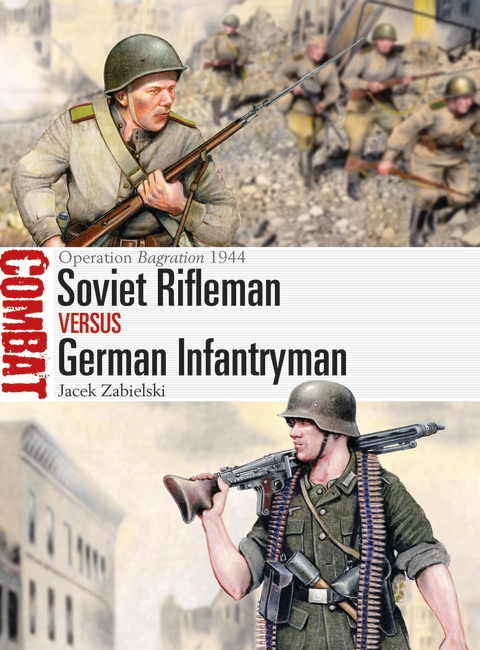
CBT 87 Soviet Rifleman vs German Infantryman: Operation Bagration 1944 explores this extraordinary campaign in detail, revealing how one meticulously planned summer offensive shifted the balance of power in Eastern Europe, and opened the final road to Berlin.
Comments
You must be logged in to comment on this post. Click here to log in.
Submit your comment