
JAPANESE
By July 1942, having captured the oil of the Dutch East Indies, Japan had achieved its main war aim. Japanese strategy in the Pacific was now to build a defensive barrier to prepare for the expected Allied counter-attack, which was predicted to come from Australia within six months, making the ‘southern seas’ the key theatre in 1942 from the Japanese perspective. A United States Navy (USN) offensive from the west coast of the US via Hawaii was, rightly, believed to be more than a year away. No thought was given to a threat to the Solomon Islands, where the Imperial Japanese Navy (IJN) was building an airfield at Guadalcanal to enable air attacks on the US to Australia shipping route.
To fend off the Allied counter-attack, a new major fleet and air base was required. Rabaul, in New Britain, the finest harbour in the region, was selected. However, it was most undesirable that Rabaul was within range of the four Allied airfields at Port Moresby. Vice Admiral Inoue Shigeyoshi, commander 4th Fleet, expressed the view that Rabaul was simply not a viable base if the fleet at anchor could be regularly bombed. From February to July 1942, Australian and American aircraft, based at or staging through Port Moresby, had made 20 raids, albeit small ones, on Rabaul, 500 miles away.
A second consideration was that Imperial Headquarters (IHQ) saw Australia as the only country in Allied hands in the western Pacific with the industry, agriculture, developed ports, airfields, population and transport to support a counter-attack. With Australia’s war-making capacities concentrated in the east, bounded by Brisbane, Adelaide, Melbourne and Sydney – the rest of the vast continent had poor communications and infrastructure – any offensive would originate from that coast directed at Rabaul via the two Australian Territories of Papua and New Guinea. It followed that the Allies would need the only useful port with airfields on the south coast of Papua, Port Moresby. If the Japanese held Port Moresby, this route would be closed.
IHQ had decided in March that it was beyond their means to conquer Australia. As a measure of their shift to a defensive stance in the Pacific, in June they abandoned plans to capture New Caledonia, Samoa, Fiji and Espiritu Santo. However, Australia’s use as the Allied springboard for a counteroffensive, and the fact that Port Moresby was within bombing range of Rabaul, prompted aggressive action within the otherwise defensive Japanese posture.
The first attempt to capture Port Moresby failed at the battle of the Coral Sea. Following the loss of four carriers at Midway, the IJN was no longer willing to risk carriers in the confined waters of the Solomon or Coral Seas. There was, however, another option. There was a viable approach from the north coast of Papua, near Buna, where a route led to Kokoda, then over the Owen Stanley Range to the back door of Port Moresby. In addition, the Rabaul–Buna sea route was 200 miles north of that to Port Moresby via the Jomard Passage or China Strait into the Coral Sea. Japanese aircraft at Lae, Gasmata and Rabaul could cover the transports along this northern route without the need for carriers. Allied air power would also be less effective with the additional distance. On 14 June, Hyakutake Harukichi, 17th Army commander in Rabaul, was told to begin the Papua operation using the Buna option.
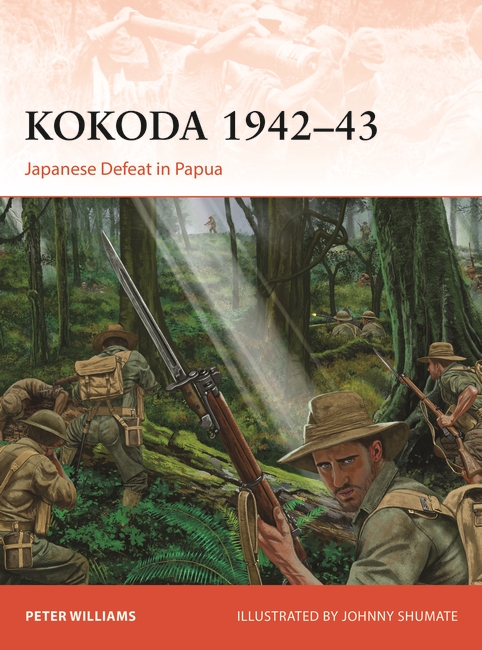
You can continue reading in CAM 425 Kokoda 1942–43: Japanese Defeat in Papua.
Comments
You must be logged in to comment on this post. Click here to log in.
Submit your comment