
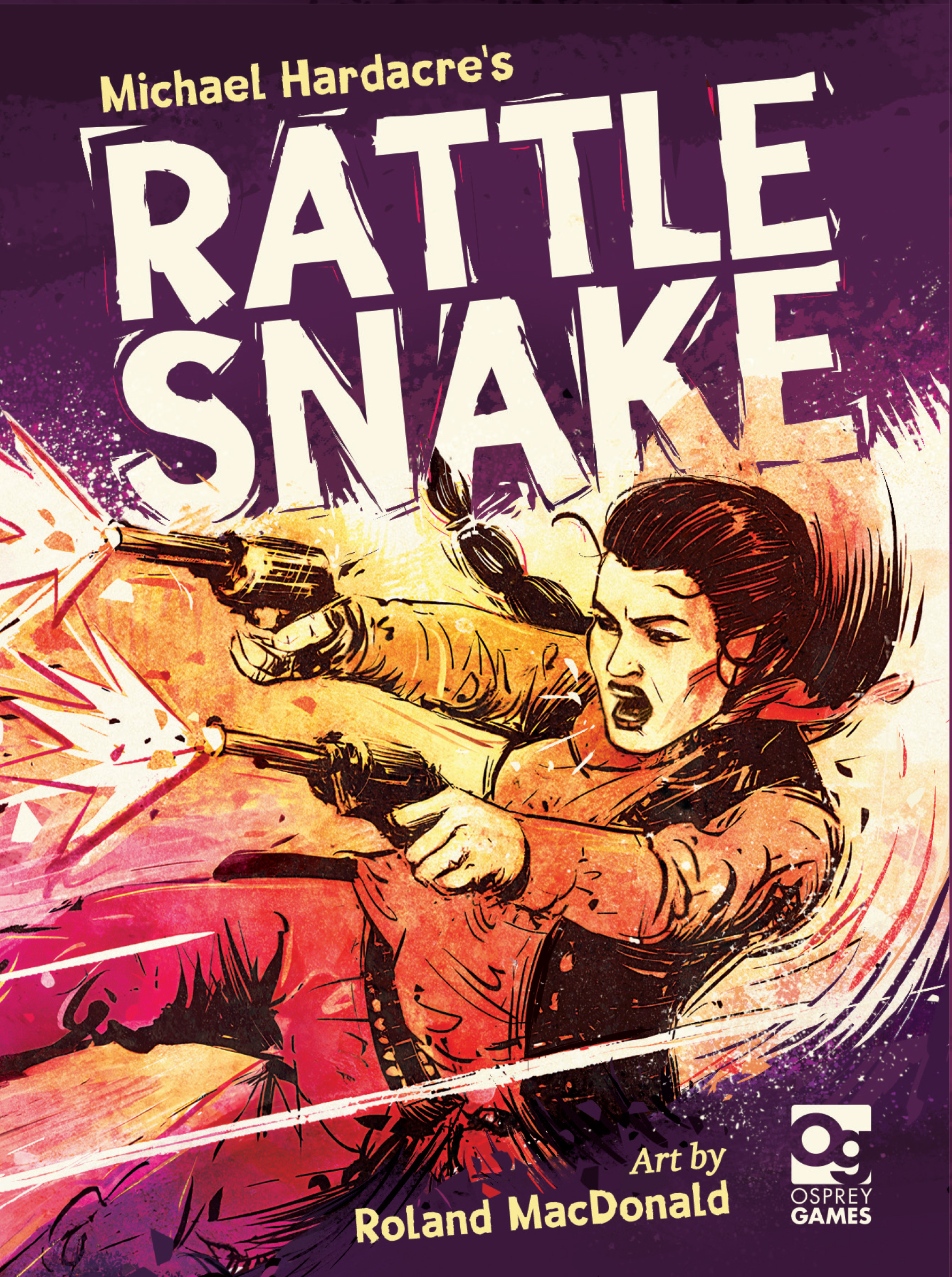
Hear from Rattlesnake designer Michael Hardacre about the creative process behind our new card game of chaotic cowboy duels...
***********************************************************************
Rattlesnake is a two-player duelling card game, lightly inspired by deck-building games. Players start the game with identical decks of cards, numbered one to five, and a central market (The Saloon) between them that holds cards for purchasing. They will take turns purchasing cards and attacking each other (or not) by placing runs (sequential numbers) or sets (the same number) face down on the table, then comparing. Defenders take a Hit card to their discard pile if the attacker wins, and when a player has no Hit cards left, they lose the game. At any time in the game, from the moment the game starts, players can play a card in their hand for its ability. The downside, however, is that card is removed from their deck permanently afterwards! As cards are bought from the Saloon, events come out that change the rules of the game permanently, and slowly push the players into finishing things. The game has an ebb and flow to it that tries to create the tension and stress of actually being in a pistol duel in a run-down western town.
Prologue:
A little about me. I am an Australian/British/soon-to-be-Italian game designer, who lives in The Netherlands. By day I am an engineer, so working with systems, whether mechanical, electrical, or cardboard-based is all the same to me. I have been making games for a few years as a hobby/fun activity with friends, but this is the first game I actually decided to publish. More accurately, the first I felt was actually worth publishing. More on that later. What I like though is telling stories. I try my best to fit a narrative into my designs in some way. The narrative might not be obvious at first glance, but Roland’s art definitely helps it stand out more. By the end of this design diary, I hope you can see the narrative in the game, and it brings it to life just a little bit more.
Act 1: We pass time between funerals and burials
I was watching For A Fistful Of Dollars one week: the original spaghetti western (Western movie made by Italian directors), directed by Sergio Leone. This is where the story of Rattlesnake starts. I was moved by the music, the cinematography, the style, and the simplicity of it all. So of course, I thought, let’s make a game about this. Naturally. There are games that do duelling much better (Kiri-Ai anyone?). I wanted to make a game that tells the story of two people who are stuck in a duel, hiding behind some scrap of anything, desperately trying to figure out how to not die. The same, yes, but also different.
The obvious link is poker. To preface, this was all started way before Balatro was released. Board games take forever to publish. The first step in developing a prototype, normally, is to experiment and fail a lot really fast. So I started researching the history of card games in the Old American West. It made sense at the time. Several Wikipedia rabbit holes later I emerged, bleary eyed, tired, and unaware of where I was, or what I was doing. So the next day I just grabbed a deck of French suited playing cards, and then made a second deck of ability cards, with random scribbled abilities on them. I wrote whatever I felt would be appropriate or just sounded cool.

Four hours pass by and the tattered remains of two playing card decks litter my desk, and my paper waste bin is overflowing and begging me to stop. This is what progress looks like. I had gone through about 20 or so versions of the possible game in a single evening. I had also ruined several fine felt-tipped pens in my haste. No time for funeral processions, or even digging the proper hole, just bury the past iteration as fast as possible. Whatever is not dead will climb out of the hole. Eventually, I actually accomplished some design work, and I came up with this bizarre system of two decks, where one would have traditional playing cards, albeit slightly modified, and the other would be full of crazy abilities and bonkers things. I nicknamed this second deck “The Michael Bay Deck”. Players could then choose to draw from either of their decks on their turn. I used spreadsheets and a program called NanDeck to rapidly print out digital versions after this.
The first playtests went well. The testers reported that the game was “a little too swingy” and other quotes like “wait, let me read that card again” and “does this really do what I think it does?”. A resounding success. The cards were built around spending your traditional playing cards (symbols on the left of the ability cards) like a resource to play abilities, but also using traditional playing cards to attack your opponent in a kind of hand comparison game (like poker, ish). Everyone did have fun though, which was a huge positive. The game was broken, but people were laughing and enjoying it. Great! BURY IT!
I churned through so many prototypes of this that I lost count. I keep almost every version of each prototype I make in general. Version control started at version 0, but each version had decimals. Even the decimals had decimals after that! There were three separate characters, each with their own ability decks, and they were all around different themes and play styles. You’d think with around 20 cards to each character, multiple copies in each deck, that it would be easy actually. But no. In the end, we were just optimising a dead horse. Don’t optimise, just bury it and move on.

What if, now hear me out…the abilities were on the playing cards? It took much longer than I will admit to reach this conclusion. It was really quite simple, I just added numbers from two to seven, plus the face cards, to the ability cards, and then one entire deck was gone. Buried! Instantly half the components! Seriously, this was a game changer, literally and metaphorically. People went from “oh, that was alright” to “shut up Michael, I’m playing here!”. Great success. I kept very, very detailed testing notes after every single game and had a wealth of info to look back through and try spot the issues. Most feedback has value in it, if you can find the nuggets of truth buried deep within. The note that helped me the most was “there are too many cards and decks”. Remove the excess and bury it.
The game was finding its footing more and more with each revision. Five card hands, both players are refreshing at the end of any turn, and abilities are one-time affairs before they disappear forever. The keyword for removing a card from the game was of course, “Buried”. My testing notes document was swelling and gaining self-awareness, consuming and digesting copious quantities of feedback and test data. Every week there was a slew of new prototypes. Monday I would test with my closed group, Tuesday I would fix it and test solo, Wednesday I would semi-blind test with another local design group, then Thursday I would fix and solo test again. The game was starting to feel more and more like two idiots hiding behind barrels and overturned tables, trying to figure out the next move in an actual western stand-off, and less of a “I play this card for X” kind of game. The downside is that I have never heard so much swearing in pubs before, and I grew up in Australia. This game brought out the worst in people. This is how I learned to curse better in Dutch as well though, so free language lessons I guess? It meant that I had tapped into the part of the brain I was searching for, poking the right neurons and getting closer each time.
Something was not right still though. So, I did what I normally do, grabbed a shovel and I buried most of it. Gone were the unique character decks, unique abilities, and also after much complaining, the black and white card design. Head play tester, and fellow game designer Steve van Bennekom, summed it up perfectly, “It looks like a spreadsheet threw up on a card game. Put some artwork on the cards please”. The Dutch are often criticised for being rude, but they just cut out all the filler words native English speakers use. Straight to the issue. There is never any “would you kindly” or “have you considered”. They make great play testers.
The game was now very similar to what you will see and play today, albeit with more cards. Symmetric decks numbered two to seven, a central market with the “face” cards, and of course wound cards. The Aces were considered as both ones and tens, depending on the hand of cards. This is what some might call the core concept. I can’t remember how many months it took to get to this point, but it was not quick. Balance was always a concern, but Steve, again, solved it in an evening's work one night. He wrote a python script that ran simulated hands both as the player and the opponent, and worked out the possibility of winning based on every single hand combination in the game. It keeps going. He then wrote me a full report, three pages long, detailing his findings, the outcomes, and where the likely overpowered combinations are. I paid for the drinks at the next test session.
Even more data in hand, I was refining more and more. This is also where the real work started. It was time to get serious. I needed more help. So I did what most normal people would do, and I started asking strangers. One such stranger was Roland MacDonald. I met him once, but didn’t know who he was at the time. I’m just going to paste some of the email I sent to him at a later date:
“We met a while back at a game design night, and you tore a friend’s prototype game to pieces (metaphorically). Are you around anytime for a chat and/or a drink?”
That’s really all it took. Turns out he lived 10 minutes from my house. We met up at a local pub, along with the friend who made the mentioned prototype (it was Steve, again). After many drinks, a long chat, we eventually tested out my game. Testing with experienced designers is a different world. Regular players give you a kind of “vibe”, while hobby designers and testers might start telling you a solution already. With actual designers and industry veterans, words sharper than razor blades is what you get. Not cruel, but precise, they cut down to the bone of the issue in a few words, leaving a huge, gaping wound that your ego, hopes, and dreams can ooze out of before you have time to blackout. It wasn’t that bad really, but you’re never prepared the first time. It feels worse, hearing these things the first time. Good feedback, would do it again. But it highlighted something I had forgotten in all the mechanisms and gameplay focus. It lacked something, some kind of spark or thing that really made it special. It was just…fine.
Act 3: You shoot to kill, you better hit the heart.
Progress slowed for a little bit as I dealt with some work things, Christmas, and regular life. This would eventually result in me taking off several months from work. Complete happenstance, but Roland also found himself without a project for the first time in a long while. So we did what British people do best, and we went to the pub…..a lot! This wasn’t game design or anything, just two guys enjoying a drink while the rest of the world was at work. It was what I imagined the feeling of zen must be like…but I am probably remembering it wrong.
Problem is, both of us are the type of people that cannot sit still. I had begun guzzling art lessons like a dehydrated dog and revising my graphic design skills while stuffing publishing information into the remaining gaps in my brain, trying to prepare for any outcome for the game. Roland however, was bored. He had gone from full-time, non-stop projects for several years, to watching me twitch uncontrollably as I struggled to find mental space for everything. I got a text one day that just said “Do you mind if I draw some artwork for your game”?


The answer is obvious. The ramp up from here on was intense. Roland and I were meeting maybe two to three times a week now, always at a pub, and we would playtest, discuss his latest card art, discuss the next changes needed. I don’t want to think how much money we drank these months.
I really hope Roland does a write up on the card art and the process he went through from initial sketches to final card art. It was really eye-opening for me, but also really shows you why it costs to buy art. The process can’t really be copied that easily, because you’re targeting human feelings, and that’s hard to do with a copy. By now, we had cut the decks down to their current numbers, with only cards numbering one to five. Eventually, we would even remove one each of the four and five cards from each player’s starting deck (players started with three copies of each card). Even the Saloon cards would be changed to match this number scale, allowing much more freedom to players to craft a play style they like. Changes now were small and gradual. A fine rasp to take the sharp edges off, rather than the surgical shovel used in the early stages.
One problem remained though. Roland hated westerns. After Western Legends, he was sick of it. I think he tried for about four weeks to find a different theme that fit the game. Sci-fi, boxing, fencing, medieval sword fighting, and other weird ideas. Eventually Roland gave in, having found no suitable replacement, and I quote “if I’m going to draw it, then I’m going to draw it how I want!” This was still a man who had asked me if he could draw the cards. What came out of this though, was a look back at the art of the period. The colours of the Old West were not fifty shades of brown, but a colourful expression of a wild landscape that played with the sun and sky. This is where the colour palette used in the game came from, and it is all the better for it!

This was now a production outfit. Roland was operating as artist, I was handling game design still as well as layout and publishing, and we both managed play testing. It must be stated, that you need to have friction when making anything. If you’re not disagreeing at least a little, something is wrong. This was not a problem for us! The best example and culmination of this was centred around the card that is now called “Dodge ’n’ Shoot”. The card ability originally was “Topdeck. If you win, ignore an Injury you are about to receive”. Topdeck just means both players reveal the top card of their deck and compare the numbers. Higher number wins, repeat ties until someone wins. This seems simple, right? Well, during a test with Roland and a friend of mine, this was the “discussion” after Roland played said card to the table and started dictating what was happening:
Michael: That’s not how that card works Roland.
Roland: Yes it is.
Michael: What do you mean? I wrote the damn card!
Roland: It is! We both Topdeck, then combat is resolved by the Topdeck! It makes sense!
Michael: No! You just ignore an injury! That is literally what is written on the card.
Roland: The card is wrong, that is not what it says!
….
This continued for a while. Eventually I stopped and tried to explain one more time what I had written on the card to Roland. The response eventually was: “Oh, I get it now….that’s dumb, why would it do that? It should just say what I said”. The table was silent for a few seconds. Then we just laughed after about ten seconds and continued playing as before. Like I said, you need friction, but maybe more important is the ability to resolve the friction. His version is in the final game by the way…
It is now March 2024, and the game is ninety percent finished. Artwork is mostly done, the rules have been ironed out to “clear enough”, and I had already started making the full 52 card print sheet. This is not normal. You should never, ever finish a game to this level before it is signed with a publisher (Kickstarter excluded). The awkward question I have been avoiding like the plague comes up, “So, ready to pitch the game now”? I am not given time to think however, as Roland most likely has already anticipated my response and simply says “Let’s go to UK Games Expo in May, it will be a good place to test it out”. I have zero excuses really, and I really should stop avoiding the part that is the most important. Flights, accommodation, and travel companions are all organised in the week. Remember how I said the game was ninety percent complete? Well, that remaining ten percent would turn out to be around fifty percent of the work.
The following is a lesson in what you should not do. The artwork was finished, and I really do mean finished, and we spent maybe four weeks arguing over colours and fonts. I have a professional ink printer at home with proper, colour accurate cardstock, so naturally we spent a few days just printing out entire sheets of cards, artwork, boxes, posters, just to see and compare the colours. We made full art boxes, Roland cut and folded card inserts, I got all the cards professionally printed and cut, and I made full-art A4 sell sheets. All in all, we made about ten or twelve “prototypes” for giving away at the expo. The week leading up to UKGE I spent a minimum of twelve hours a day working on something, Roland was working on my desk next to me for about eight of those hours usually as well. It was also absolute overkill, and you shouldn’t ever do this!

So, UKGE rolls around in Birmingham. The first day was all business. Roland dragged me around the expo, introducing me to publishers, sneaking some prototypes into their hands, other designers, and even a couple of pitch sessions he managed to organise last minute. I said little, just watched and learned, answered some questions when people asked me, and tried incredibly hard to absorb all of it. There was so much nuance to dealing with publishers. Nothing is ever a no, but it is an opening for another question though. The amount of info is overwhelming. Sometime in the afternoon Roland told our friend and I that he was off to have meetings for several hours, so we went off to actually explore the expo for the first time that day, and maybe even play a game or two!
Beer o’clock finally arrives (have you noticed the pattern yet?) and we head to one of the terraces outside the expo to relax and wait for Roland to catch up. It is sunny in England, serenity around the terrace, the dull patter of a nearby fountain and birds, and all is right in the world for a few minutes. Then Roland arrives and it begins. He’d been off with Trevor Benjamin (one of the designers for the Undaunted series, among other things) testing the game. Trevor liked it, and said he should show it to Osprey. What a coincidence Roland had a meeting with them shortly! They liked it also apparently. To top it off, the person at Osprey who would likely review it later was a huge fan of Westerns. I made sure to point that out to Roland every single chance I got by the way. Remember exploring the different themes Roland?! Remember! I know you will eventually read this! Long story short, Osprey were keen, and would review it internally and let me know at a later date. Business as usual.
You’ve seen the box art, and the title, and the BGG listing so you know they took the game. But the story isn’t over. This was just Friday at UKGE, and I had booked myself a table at UK Playtesting for Saturday afternoon, I think it was three hours long? If you don’t know who Playtest UK are, look it up. A really great, helpful community that organise playlists all over the UK. I arrived on time, setup a couple of copies on the table, put the marketing stands, sell sheets, business cards and posters up. People came here expecting prototypes, so they knew what they were getting into, but still they are all very understanding. Every single person filled in the feedback forms, and gave really positive comments. I exchanged a couple of business cards with different publishers wandering around, as well as chatting with one or two others who were’t looking for this type of game, but really wanted to know more.
End Credits:
***********************************************************************
Find out more on BoardGameGeek.
Read the rulebook on our gaming resources page.

Comments
You must be logged in to comment on this post. Click here to log in.
Submit your comment