
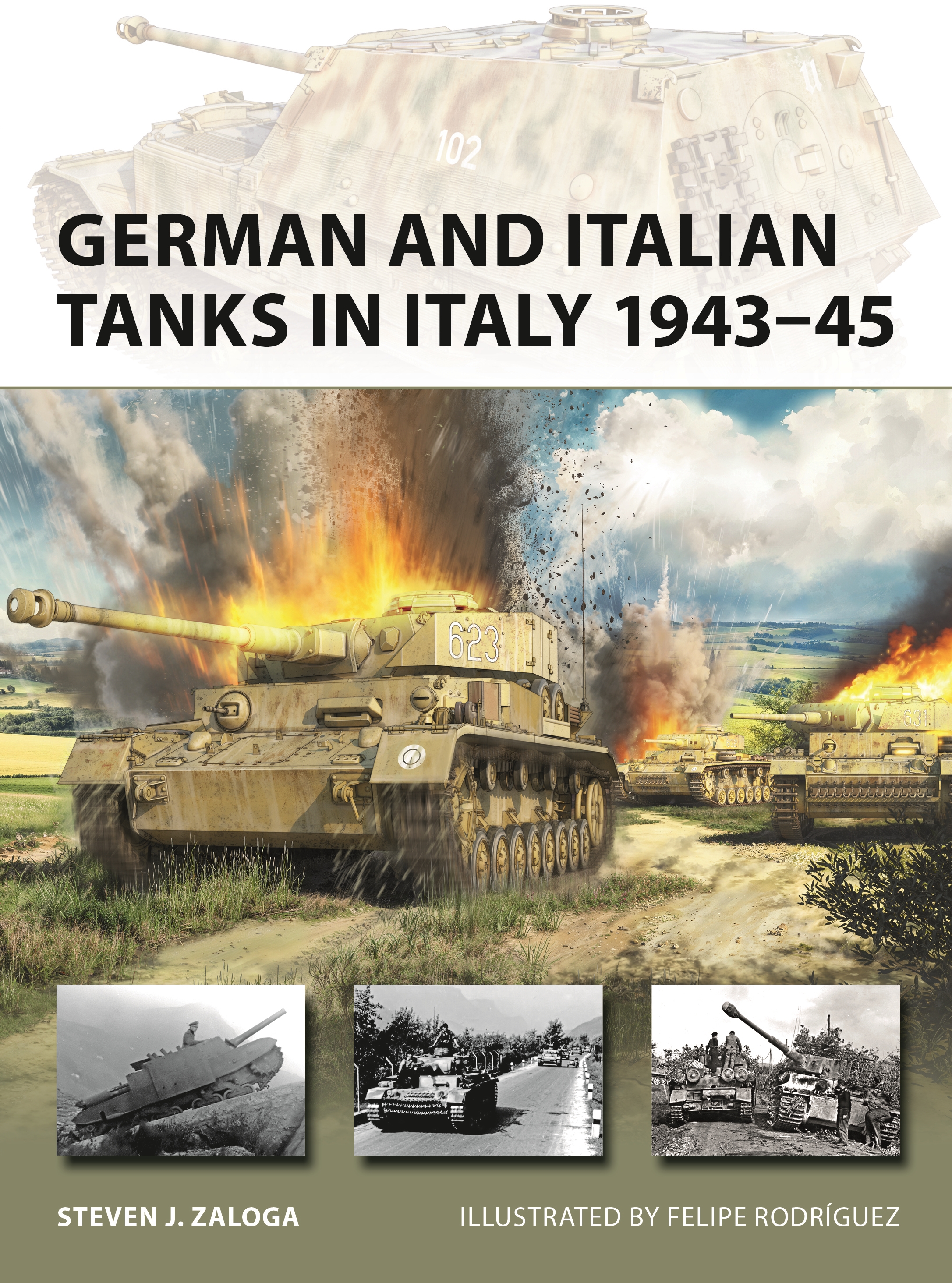
The Italian campaign of 1943-45 is very well known for its many dramatic battles including Sicily, Salerno, Cassino, Anzio, Rome, and the Po valley. But the Italian campaign is not usually associated with tank combat. There’s a perfectly good reason for that. Italy’s mountainous terrain is hardly conducive to maneuver warfare. Nevertheless, tanks were widely used by both sides during all of these battles, even if their role is little known. This book looks at the Axis side of the picture, covering both German and Italian tanks. It begins with the Sicily campaign, the only campaign in this theater that saw extensive use of both German and Italian tanks. The Italian tanks on Sicily were a particularly curious selection based around war-booty French Renault R35 infantry tanks. As mentioned in the book, the Italians were hoping to get enough Charb B1 Bis and Renault R35 to create an entire armored division to fight in North Africa. This didn’t occur, and Sicily was the swansong of Franco-Italian tank use. There were other curiosities on Sicily including old Italian Fiat 3000 light tanks, an Italian copy of the 1917 era Renault FT.
When Italy switched sides in September 1943, the Wehrmacht swept in and gathered the remainder of the Italian tank inventory. The Germans had anticipated the Italian defection, and it was no coincidence that there were more Germans tanks in Italy in August-September 1943 than at any other time during the war. Once the Italian army was disarmed, the Wehrmacht units in Italy inherited a large number of M14/41 tanks and Semovente assault guns. The Germans really did not like the Italian tanks, and most were shipped off to the Balkans for the use by anti-partisan units. However, the Semovente had decent firepower, and so many German infantry divisions in Italy were reinforced with a company or more of these vehicles. German tanks in Italy included the usual panoply of types, particularly the PzKpfw III and PzKpfw IV.
The Panther was very rare in Italy, only a single battalion committed at the time of the Anzio landings. There were two battalions of Tiger, but their combat performance was uninspiring due their poor automotive performance in the mountainous terrain. The Elefant made a brief appearance in Italy as a swansong after the 1943 battle of Kursk. A few late war types also arrive din the concluding months of the campaign, such as the Jagdpanzer 38 “Hetzer”. But the German Panzer force in Italy in 1945 had a distinctly Italian flavor with hundreds of Semovente wearing the German cross insignia. Strangely enough, there were more German tanks and assault guns in Italy in April 1945 that there were in Northwest Europe/European Theater of Operations at the same time.
This book is graced by Felipe Rodna’s superb color plates. German tanks in Italy tended to be fairly bland, typically a uniforma coat of dark yellow camouflage paint. Fortunately, the Italian vehicles sported some of the most attractive color schemes of the war, adding some vibrant interest to the color plates.
Read more in German and Italian Tanks in Italy 1943–45.
Comments
You must be logged in to comment on this post. Click here to log in.
Submit your comment