
Until the last quarter of the 20th century, the modern impression of Roman helmets was dominated, as with so much about the Roman Army, by the reliefs on the helical frieze on Trajan’s Column in the centre of Rome. This was despite the fact that actual examples of Roman helmets have been known from the archaeological record since the 19th century. European scholars began to sort them into different categories in the 20th century, but it was the publication of H. Russell Robinson’s The Armour of Imperial Rome in 1975 that produced a detailed, systematised categorization of Roman infantry helmets from the Republican and Principate eras. At almost the same time, Hans Klumbach in Germany produced an overview of the (far fewer) known examples of Late Roman helmets of both infantry and cavalry.

[Infantry helmets on Trajan’s Column (photos MCB)
Robinson used the principal categories of Montefortino, Coolus, Imperial-Gallic, Imperial-Italic and Auxiliary Infantry to cover the infantry helmets of the Republic and Principate. He differed little from other scholars in his identification of so-called ‘jockey cap’ helmets (Montefortino and Coolus), but split the European Weisenau grouping between his Imperial-Gallic and -Italic, based largely on where he thought they had been manufactured (the clue is in the names he gave them). His system, which has never been wholly satisfactory, seemed increasingly less sound the more helmets were recovered. Additionally, he had a category that he termed Auxiliary Cavalry helmets, which included some 2nd and 3rd-century AD helmets that (it became increasingly obvious) had belonged to infantry, typified by the Niederbieber type.
The task of reconciling Robinson’s and the European systems, at the same time as accommodating new archaeological finds, is not easy, but it can be done. It is aided by certain key data points – for example, infantry helmets tended to have carrying helmets in the middle of the neck guard, from the middle of the 1st century AD onwards, and they had brow guards to deflect downward blows to the face. Similarly, from the early 2nd century, cross-piece reinforces were added on the bowl, probably initially to counter the scythe-like blades of the Dacian falx, which was capable of penetrating the mild steel of a Roman helmet. Ownership inscriptions on helmets – Roman soldiers purchased their equipment and paid for it with deductions from the regular pay – can provide clues, particularly where units were named or the form of an individual’s name suggests his status.
Nearly every aspect of an infantryman’s helmet was functionally determined by the type of combat in which he was likely to be involved. He not only had to contend with opposing infantrymen operating on his level, but there was always the chance of cavalry attacking him from a higher vantage point. The neck guard of his helmet defended against blows to his shoulders and neck; hinged cheek pieces covered the sides of his face (with carefully angled flanges deflecting blows outwards and away); and, as we have seen, the brow guard protected his face and cross-pieces reinforces strengthened the bowl itself. Additional corrugations around the base of the neck and on top of the neck guard, as well as the ‘eyebrows’ of Robinson’s Imperial-Gallic type, further enhanced the protection offered by a helmet.

The original Weisenau helmet (Lindenschmit/ Public Domain)
Both copper alloy (bronze in the Republican period, brass in the Principate) and mild steel were used to make infantry helmets. This was probably due to availability of the requisite ores (one of the reasons Robinson defined his Imperial-Gallic and -Italic groupings). Nevertheless, movement of units around the empire meant the resources available to them could change, while cross-fertilisation of ideas between craftsmen of different units, and these factors served to make the available varieties of helmets extremely complex.
Roman writers record that the legions had the craftsmen necessary to produce helmets. Like all armour, they only worked with a padded lining that could provide a secure fit and help absorb the force of a blow to the head delivered by an attacker.
Helmets were of course a chance for soldiers to adorn themselves as they saw fit. Crests and plumes enhanced their height and could introduce swathes of colour into an army. Tinning and silvering were common, as much to look magnificent as to provide some protection against corrosion. Contrasting ferrous and copper-alloy components only added to the visual appeal of headgear.

Crest fittings from Roman infantry helmets (Drawings MCB)
Throughout their development, Roman infantry helmets had one thing in common: the fact that their origins always lay with the equipment of peoples Rome had encountered on the battlefield and subsequently adopted (and adapted). The Montefortino, Coolus and Weisenau/Imperial-Gallic and -Italic helmets were all derived from helmets of the inhabitants of north-western Europe. By contrast, the Late Roman ridge type helmets were adopted from steppe prototypes to the east, which appealed because their composite construction was less troublesome than the earlier one-piece bowl examples. Arguably, the only true Roman development was the Niederbieber type, with their deep neck guards and close-fitting, large cheek pieces, and these were only a natural progression from Early Principate helmets.
However they are classified, the helmets of Roman infantry reveal an evolution over time that reflected the Roman Army’s receptiveness to change when the advantages were obvious. Some, like the field modification of adding cross-pieces to the bowl, occasionally speak to the urgency that led to this flexibility.
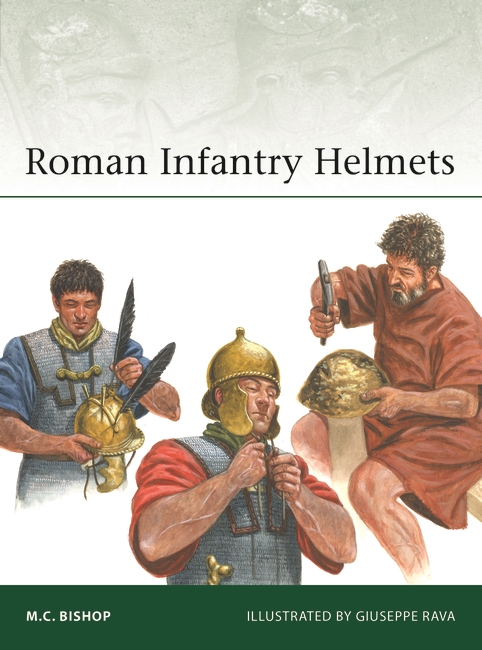
You can read more in Roman Infantry Helmets by M.C. Bishop.
Comments
You must be logged in to comment on this post. Click here to log in.
Submit your comment