
Like many of my generation, I had relatives who had served in the RAF and the FAA during the Second World War and was brought up on stories of derring-do about dashing RAF pilots. My particular interest was the night bombing of Germany (family connections again), and during the 1970s, I began to see the ‘other side of the hill’, which has left me with an abiding interest in the Luftwaffe’s nightfighter arm.
A working life devoted to the production of high-quality open-source information concerning defence electronics led to my interests coalescing around the electronic ‘War in the Ether’ between the RAF and the Luftwaffe. Having authored a number of history titles in the past, I was pleased to be approached to write a history of the Heinkel He 219 nightfighter’s service.
So, what of the Heinkel He 219 itself? Given that I had previously researched the ‘219’s armament and avionics, my development of this book has had the added advantages of my access to what I believe is the largest collection of He 219 photos in the UK; the groundbreaking work of Theo Boiten, R Francis Ferguson and Roland Remp; the illustrative work of Janusz Światlon and Gareth Hector, and the help of Luftwaffe historians Eddie Creek, Robert Forsyth and Chris Goss.
Having completed the book, I realise now that the He 219 is even more interesting than I had originally thought. Not only was it the Luftwaffe’s fastest nightfighter, but it was also subject to a prolonged and painful production cycle, and it was the first operational aircraft to offer its crews the benefits of a viable ejector seat system. It was not, however, ever officially called the Uhu, nor was it ever an effective Mosquito ‘killer’. Here, it is clear that the ‘219 was simply not able to match the speed and,more importantly, speed at altitude to earn such a reputation. Granted, it did shoot down Mosquitos, but against the highest-flying, two-stage Merlin-powered Mosquito variants, ‘kills’ seem to have been a matter of luck rather than performance. Moreover, the small number of ‘219s, together with the relatively small numbers of Mosquitos in German air space at any one time, only decreased the likelihood of the two meeting at any given time.
The Britist test pilot ‘Winkle’ Brown concluded that the He 219 was underpowered for its size (giving the lie to some of the more extravagant claims – including those of bomber leader Peltz – concerning its ability to fly on one engine with ‘everything down’), and after studying the type, I am inclined to agree. The ‘219 never benefitted from engines that would have given it an edge, with virtually all such hopes instead centring on the Jumo 222 (which, in any case, did not live up to expectations and never entered series production). From other quarters, one gets a sense that the ‘219 was never really fully developed and suffered a niggling range of ‘bugs’ that should have been worked out prior to its service entry. Readers needing convincing of this should remember that the vast majority of airframes produced were to the A-O pre-production standard, with the A-2, A-7 and E-1 models all being variations on this theme.
That the He 219 was an efficient heavy bomber ‘killer’ is a given; in the hands of its best pilots, it was lethal. On the other side of the coin, the ‘219 was never in service in large enough numbers to make a real impact, and as a result, was probably a less effective nightfighter than the ‘workhorse’ Ju 88 G-1 and G-6 aircraft.
Are there mysteries to be solved and new facts to be uncovered concerning the He 219’s design and service record? Of course there are. Hopefully, we will see the emergence of fresh photographs of the type, too. One of the most interesting ‘rabbit holes’ not yet looked down here is whether or not NJG 5 received the ‘219 alongside NJG 1 and NJG 3; I would be very interested to hear from anybody out there who knows the answer to this one.
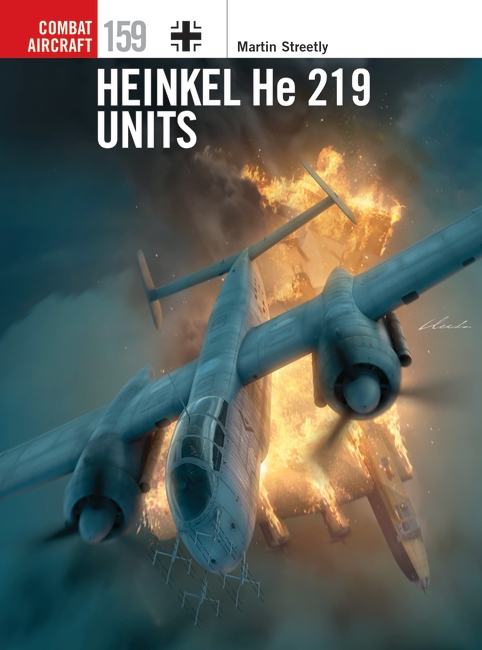
So, dear readers, there you have it. The book, which I hope you will enjoy, can be best seen as an He 219 primer that gives insights into the type’s development and combat use (I believe it provides extensive coverage of the ‘219’s combat record from June 1943 to May 1945), as well as what ‘might have been’.
COM 159 Heinkel He 219 Units is available now.
Comments
You must be logged in to comment on this post. Click here to log in.
Submit your comment