
Very little is available in English naval literature with regard to the battles in the Adriatic Sea during WW1. The situation in Italy is even worse: source material is often reprints of works published 100 years ago or second-hand accounts and articles based on older sources which offer a unilateral viewpoint, while rehashing old tropes.
There seem to be two causes for this: firstly, not many people outside German-speaking countries are fluent in German, and Austro¬Hungarian papers and publications remain largely unexplored. Secondly, the Archives of the Ufficio Storico della Marina Militare (The Italian Navy Historical Branch) are substantially untapped and most researchers content themselves with the accounts produced by the Italian Navy a few years after WWI such as the Cronistoria documentata della guerra marittima italoa-austriaca 1915¬1918.
Reluctance to tackle archival sources is understandable. The records are contained in 617 unclassified files (‘Raccolta di base, miscellanea”: Basic documents, miscellany’) and include the original proceedings, reports and data. This collection was not reorganized after 1945, as WWII studies were top priority. I have spent years examining, and cross-checking these files, and investigating Austrian sources available at the Österreichischen Staatsarchiv/Kriegsarchiv of Vienna to rediscover a host of unknown facts; stories, forgotten (in both Italy and Austria) surface actions, fleeting gunnery duels and much else.

The Battleship Dante Alighieri sorting from Taranto (Author Collection)
British and French primary sources were also used and this book is the final outcome of that lengthy research work; it provides a complete overview and a refreshingly new study into a relatively ‘obscure’ topic.
The content covers all the surface actions fought in the Adriatic Sea from 1914 through to 1918, with the losses and damages caused by mines and aircraft, the coastal defences on both sides, logistics, technology, training, doctrinal development (if any), lessons learned and, last but not least, Intelligence.
It is important to point out that, as with my previous Osprey title - Fleet 6, Italian Battle Fleet 1940¬43, La Squadra - my work is based on a few key points:
a) during WWI (and still today, for that matter) politicians and journalists base their ideas about naval warfare on a cursory reading of the great American navalist Alfred Thayer Mahan's work. They seem to believe that war at sea is like a medieval tournament - two enemy fleets meet, by mutual consent, somewhere over the ocean and the winner wins the war. Admirals, after a century of colonial or smaller conflicts, from the end of the Napoleonic Wars, were inclined to share this belief in ‘The One Decisive Naval Battle’, a super-Trafalgar to end any war with a single stroke.
The British navalist Sir Julian Corbett begged to differ and tried from 1905, with little success, to explain that this concept was nonsense. Bearing this in mind, in 1914, the Germans were expecting a Home Fleet’s sort of Balaklava Light Brigade charge across the defensive lines of minefields, submarines (by day) and torpedo boats (by night) of the Kaiserliche Marine somewhere off Wilhelmshaven or Emden.

An example of the secret documents recovered in 2016
This big battle fixation also couldn't help influencing the naval doctrine of the two Adriatic Sea powers: Italy and Austria-Hungary. In fact, battleships on both sides ended up playing a ‘goalkeeper's role’ while light forces fought plenty of minor - and not so minor - actions.
b) In my previous Osprey book I tried to clarify how much the Italian strategy of 1940-45 was driven by political and economic motives. This applies to all nations at war, however the key point is that island nations such as the UK, and continental masses such as the USA, have for a long time been invasion-proof as they are already defended by sea/ocean expanses and large and powerful navies, factors allowing strategic freedom and opportunities continental nations can only dream of. From 1860 onwards, Italy's GDP, fixed capital investments and productivity rate steadily grew, but the country's strategic weaknesses was always there.
c) In developing a national strategy, Italian governments and their military had to take into account the state of the economy, social conditions and future prospects. As the Italian Prime Minister Antonio Salandra stated openly in October 1914, there was little room for flights of nationalistic fancy. Since the 15th century, all major Italian states - the Duchy of Savoy, the Kingdom of Sardinia, the Republic of Venice – had had to be realistic for survival's sake, and the post-1861 Kingdom of Italy was no exception ¬ a hard truth that emerges from Italian source documents.
Intelligence proved to be a valuable tool, however. My account of how it came about was helped by the discovery in June 2016 of the HUMINT Archivio segreto (Intelligence archive in the basement of the Italian Naval Ministry. A mysterious trunk was found. It turned out to be the Regia Marina’s HUMINT Archivio segreto, hidden on 9 September 1943 by Admiral Augusto Capon, former Director of the Reparto Informazioni dello Stato Maggiore della Marina - Italian Navy intelligence - and father-in-law of the famous physicist Enrico Fermi. The SIGINT part of the Archive had been entrusted by the then Director, Rear-Admiral Franco Maugeri to Admiral Alberto Lais, another previous Intelligence Chief and an Axis spy. Lais's task was to make sure the archive would not fall into either German or Allied hands. In June 1944, he handed the archive back to the Italian Navy, and those documents allowed me to debunk conventional ULTRA historiographical misunderstandings, and the contrasting narratives of the Allied Mediterranean war made by differing accounts.

Another document from the Archivio segreto (Author Collection)
Capon was deported to Poland on 16 October 1943. He did not divulge his secret and died during the transfer to Auschwitz before Commander Junio Valerio Borghese could intercede for him. I was asked to study his recently rediscovered papers and was able to reconstruct both the Italian naval infiltration work into the Austro-Hungarian and German navies and intelligence agencies active between 1915 and 1919 (continuing through the interwar and WWII years until 1943); also the Italian naval Intelligence's underground work against the British and the French - allies, but not friends throughout WWI.
Studying those documents proved remarkably enlightening for a better understanding of the real course of the Great War - in particular, the complex and partly obscure closing phase of the conflict.
This new history of the Adriatic naval war within WWI is enhanced by a number of previously unpublished photographs, detailed artwork and magnificent battlescenes.
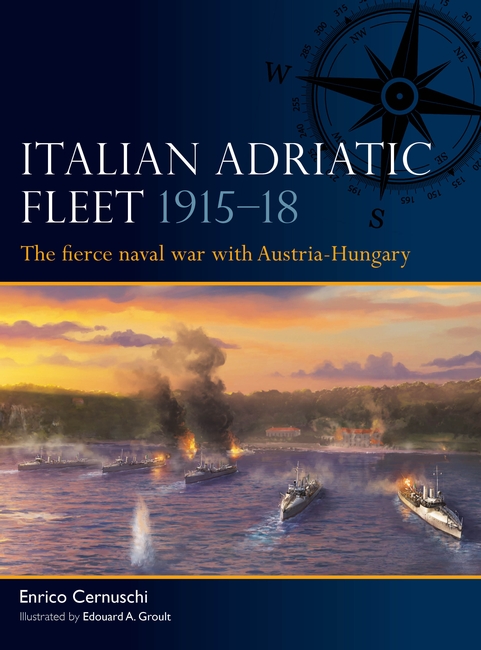
Read more in Italian Adriatic Fleet 1915–18: The fierce naval war with Austria-Hungary.
Comments
You must be logged in to comment on this post. Click here to log in.
Submit your comment