
The Battle of Kadesh (1275 BC), fought between the Egyptians under the pharaoh Ramesses II of the Nineteenth Dynasty and the Hittites led by their king Muwatallis, is one of the crucial military encounters in the ancient world. It has always interested me owing to the numerous Egyptian war records, both pictorial and written, that recount this clash in Syria close to the River Orontes. In fact, in any collection of the most famous, decisive, and historically significant confrontations this remarkable encounter would be automatically included. True, you will not find it in Sir Edward Creasey’s analysis of fifteen decisive battles. But that study was published in 1851 and it commences, as one might expect of the age, with Marathon in 490 BC. Major-General J. F. C. Fuller included Thutmose III’s famous Megiddo battle of mid Dynasty Eighteen in the first volume of his Decisive Battles of the Western World (1954) with some detail, but the Kadesh encounter of Ramesses received a mere two paragraphs — and short ones at that — and the victory of the Egyptian weas called Pyrhhic, a completely false interpretation.
The wealth of direct information from the Egyptian side lulls one into at first accepting the interpretation. Ramesses travelled north at the head of his army with four divisions. He strategy was to wrest control of the important province of Amurru, with Kadesh as its metropolis, from the Hittites. For years the relations between Egypt and the Hittites had been hostile. By the close of Dynasty Eighteen (ca 1292 BC) on and off clashes on the borders of both zones of power in this key zone of Lower Syria has become commonplace. The Hittites had effectively taken control of the region during the reign of Akhenaton and subsequent campaigning by pharaoh Horemheb overtly indicated that the Egyptian pharaoh would personally involve himself in any attempt to control the region as the geopolitical ramifications were highly significant.
Subsequently, Ramesses’ father Seti I had campaigned in person and met on the battlefield a Hittite army. He further reached Kadesh and claimed, at least in his war reliefs, to have taken control of the capital. Subsequently, however, the political sector swung back to Hittite control and owing to this decided change Ramesses felt it necessary to amass a major army and advance northwards into the heartland of Syria. A fifth division was to meet up with this major body of troops at the west of the Orontes and not too far from the city of Kadesh which lay on the east side.
The battle, as recounted solely from the Egyptian records, was a victory for Ramesses. But for anyone who has examined the various temple accounts it is readily clear that he first encountered a major threat — indeed he was trapped in his camp — and then had to fight himself out of the bivouac from attacking Hittite chariots. To many it is the sole use of those mobile vehicles that provides a strikingly interesting and remarkably well performed act of military engagement. This is yet one of many facets of the military contest that intrigued me to no small extent. Despite the wealth of information provided, it is obviously one-sided. Purely from his information-gathering servants — spies and others — he did not realize that Muwatallis was already ensconced at Kadesh and had set up his own infantry and chariots for an effective unsuspected charge across the Orontes westward, aiming right at the central control of the Egyptian divisions. He had already ascertained that the Egyptians would arrange their camp to the west.
This battle accounts further provides to the readers and onlookers of the pictorial evidence a hefty amount of information that enables one to reconstruct the entire scenario very carefully and indeed quite dramatically. Thay is why I, and others, have been particularly attracted by the seemingly ineptitude of Ramesses before the actual Hittite attack, but yet very captivated by the pharaoh’s remarkable and personal defence of his camp and his first division (called Amun) which was under siege by the fast moving enemy vehicles coursing north after they had sliced through and incapacitated the king’s second division (that of Pre) to the south.
Furthermore, the major written record of the clash — called by Egyptologists the Kadesh Poem — allows all of us to see, witness and experience the developing threat of the Hittites while the king was still settling down in the north. Ramesses in fact beseeches his father-God, Amun-Re, for help and succour when he was given the fatal news that Muwatallis was nearby and not, as he expected, far away in the north of Syria. At this point the lengthy narrative of the Poem offers a very personal address of Ramesses to Amun wherein he castigates his officials and troops for not helping him and implores his deity for success. This portion of the composition is considered to be a high mark in the contemporary Egyptian religious pietistic fervour of the age but it is much more than that.
In essence, the Egyptian historical account of the battle offers a first person interpretation on the part of the war leader and monarch. Hence, the personal side of the events comes to the fore, and this is an additional reason why anyone engaged in reading the epic of the Kadesh Poem ends up totally involved in the entire scenario and not just in the juxtaposition of both armies, their locations and number of troops engaged.
The Egyptian records were carved in five disparate temples. Proceeding in a southerly direction they are: Abydos (the shrine area of the god Osiris), Karnak (the main temple of Amun), Luxor to the west close to the king’s own mortuary temple, the Ramesseum. All three of these were at Thebes, the southern religious capital of Egypt at this time. The fifth temple where the Kadesh scenes and texts can be found is Ramesses’ well-known rock edifice at Abu Simbel. It is in fact that Giovanni Belzoni in 1816 founded Egyptian military studies by reaching the shine and investigating it. To this day Abu Simbel and the Kadesh reliefs that were carved there remain a highly attractive site for tourists, travellers and investigators. Owing to this the Kadesh Battle has established itself as a key event in the mind of numerous visitors and laypeople interested in ancient pharaonic Egypt.
Ramesses discovered the trap and managed to engage in a bloody chariot upon chariot attack in the open field sough of his camp. He first deflected the enemy vehicles and then, with the help of his fifth division nicely arriving “in time” — it is called the Na’arn — he pushed the opponents back to the river. The reliefs and the inscriptions tell of this valour to be sure but purposely contrast Ramesses’ personal courage with the absence of Muwatallis’. The Hittite king never engaged his foes in combat, preferring to direct his forces from the east, situated at the city of Kadesh itself rather than going in person westwards. To be sure, the Egyptian artists and literary compilers of the later accounts made sure not to ignore Muwatallis’ assumed cowardice.
The Battle of Kadesh is as interesting as it is also fascinating because the narrative is presented in poetical format. Written in a developed poetical style the Kadesh Poem is a rather lengthy narrative presentation in which the entire battle of presented chronologically. From the outset at the East Delta up to the city of Kadesh the background to the inevitable military clash all is ably written. The king appears in a very vulnerable guise but remains always stout hearted, effective in combat, and a true warrior. In addition, he repeatedly encourages his troops and specifically, during the second half of the conflict, he talks with his charioteer Menna, the only non-royal personage who is named, signalled out and described with any detail in the historical report.
After effectively repulsing the Hittites surrounding, if not partly in the camp and defeating them in the field, Ramesses then had to face a second Hittie chariot attack from the east. Muwatallis had discerned that his first strike had failed. It had been a gamble to be sure, especially when we consider that no infantry were involved. The second onslaught nevertheless involved once more only chariots. Here other key players from the enemy side participated, the various allied Hittite potentates. Again, Ramesses caught them in the field and defeated this new rush of troops. It has to be stressed that all of his successes were fought with the able support for his first division, that of Amun, and with the added underpinning of the Nar’rn troops. In essence, although the texts do not indicate this, Ramesses had at his fingertips two Egyptian divisions. Yet he never applauds the able assistance of the Na’arn.
At the conclusion of fighting Ramesses emerges as the sole victor, of course. To many he appears overly egotistical when he mentions that his only support through the entire day — and it took some time from early afternoon to possibly early twilight to conclude the fighting — were from a few. He specifically lists his two chariot teams as well as the “butlers,” personal elite troops in the camp, who has supported him. (I ignored his father-god Amun.) This attitude we can see from the very start when he blames his officials (at home and in the north) as well as his own soldiers for not altering him to the Hittite threat. Indeed, he only discovered Muwatallis’ location after he set up his camp. This personal self-centred attitude stays with one when the conclusion to the first day is recounted. It is, in fact, repeated many times.
The Battle of Kadesh did not cease then. On the second day, as part of what had to be a “set piece,” Muwatallis sent additional troops westward to engage — one might say “to try” — Ramesses again. The pharaoh defeated for the third time this new foray of the enemy. Then a patch-up was arranged by which the Egyptian army could depart from the region without any further opposition. Ramesses did just that.
Here then is to many a further reason to be involved in the narration. Clearly, Ramesses had lost strategically. He failed to obtain his goal, and that was the surrender of the city of Kadesh. On the other hand, he most certainly won in combat and that is surely why this battle was regarded — at home! — as a resounding victory of arms on the part of the pharaoh.
To me, viewing the clash from so many years so personal research as well as engulfing myself in numerous studies on the military strategy (or lack of it) of Ramesses’ courage, and that of his terrified troops and victorious charioteers as well, it is an endless task of evaluation and re-evaluation. Was, for example, Muwatallis that weak as the Egyptian account stresses? I believe so, but only in the size/number of his troops. But he wisely had prepared his defensive position well and hid his presence from any spies of Ramesses. He was to me a very shrewd war leader, one who would not sacrifice his troops even if it might have been a good general policy. In contrast to Ramesses, Muwatallis was a commander who weighed up all the possibilities that he could envisage and then acted. I.e., he was considerably more sagacious than Ramesses. But were his chariots forces not so great in number, or not as numerous as the Egyptians’, or at least during the opening foray? After all, Ramesses had at his fingertips only two divisions’ worth of effective troops for combat. Indeed, just how far to the south were the isolated third and fourth divisions of Egyptian soldiers. Yet what about day two? Why was this “show of army,” surely an honourably planned military sally, allowed to take place? Was it to placate both sides, neither having achieved what he actually wished? Moreover, the timing of the earlier clashes remain unclear and it would have been useful to know just how long the two chariots assaults occurred.
Many more questions can be raised, even if most, I sadly believe, will never be answered. The Egyptian accounts hold their own, not merely owing to their remarkable first rate literary aspects but also due to the numerous remarkable pictorial aspects of the troops marching and fighting. And the failure of Ramesses right from the start, one that involved intelligence gathering, is significant to remember always. I.e., watch out! This battle has never departed from my mind since years ago when I was a student. I believe that if studied it will equally remain emotionally fixed in others’. It is an excellent case of a strategic failure notwithstanding anything, indeed everything, else.
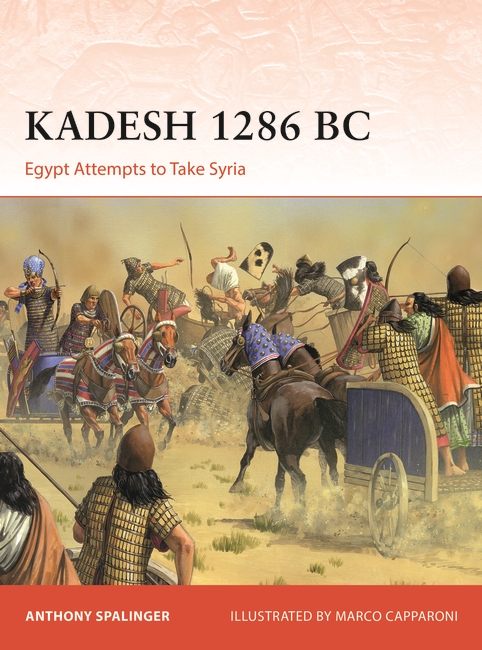
You can read more in Kadesh 1286 BC: Egypt Attempts to Take Syria.
Comments
You must be logged in to comment on this post. Click here to log in.
Submit your comment