

Today we're showing three pieces of artwork from our August 2026 series books! Let us know in the comments which books you'd like to see featured in our September 2026 Artwork Reveal!
Roman Army Units in the Eastern Provinces (3): 4th–5th Centuries AD
By Raffaele D’Amato
Illustrated by Raffaele Ruggeri
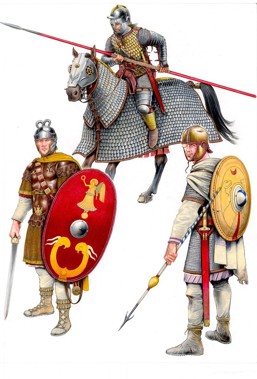
THE DIOCESE OF THRACIA
1: Centenarius of the Celtae, auxilium palatinum, army of Constantine I, battle of Adrianople, 324
2: Eques, equites catafractarii Albigenses, battle of Utus, 447
3: Miles, mattiari seniores, Adrianople, 378
Donbas 2014–15: Undeclared and Uncivil War in Ukraine
By Mark Galeotti
Illustrated by Marc Lee
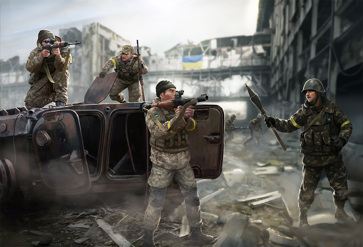
THE SECOND BATTLE FOR DONETSK AIRPORT, NOVEMBER 2014
A sniper from the 95th Airmobile Bde kneels atop the burnt-out shell of a BMP-1 IFV from the DNR’s Oplot Bn, left from earlier fighting, scanning the surroundings through the scope of his SVD rifle. He is being joined by one of the handful of operators from the 73rd Naval Special Operations Centre who helped relieve the defenders, in newer pattern digital camouflage and with the 73rd’s seahorse unit patch. A soldier from the 93rd Mechanized (Mech) Bde, who has just fired his RPG-7 anti-tank launcher, calls to a colleague to hand him a new PG-7VL grenade, while in the background two more soldiers lug a 12.7mm NSV Utyos heavy machine gun into cover.
Art requested by Karl Dietrich.
Royal Navy Mediterranean Fleet 1793–1805: The war at sea against Napoleon
By Casey Baker
Illustrated by Edouard A. Groult
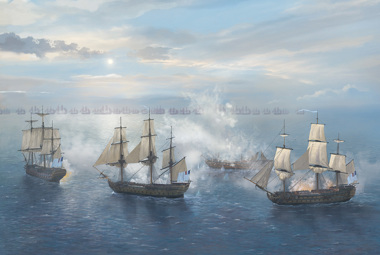
Battle of the Levant Convoy
On 7th October 1795, a French squadron of Cdre Joseph de Richery surprised the Levant Convoy off Cape St Vincent. The British force protecting the convoy was caught unprepared for Richery’s force that escaped Hotham’s blockade of Toulon earlier in the fall. In the battle, the Censeur, damaged months before and scheduled for major repairs in a home port, could not defend itself and was overwhelmed by the French line of battle. Thirty merchant ships from the convoy were also captured, the greatest defeat on a British merchant convoy in the Mediterranean since Lagos in 1693. The defeat of the convoy was one of the dark days for the Royal Navy in the Mediterranean and reflected the degradation of maritime security across the region. In British hands for less than six months, the Censeur was renamed Révolution and served in the French navy until 1799. Transferred to the Spanish, the ship was subsequently broken up. Richery’s victory reflected the dangerous circumstances regarding the withdrawal of Spain from the First Coalition, a geopolitical condition that declined further when Spain allied with France in 1796.
Comments
You must be logged in to comment on this post. Click here to log in.
Submit your comment