
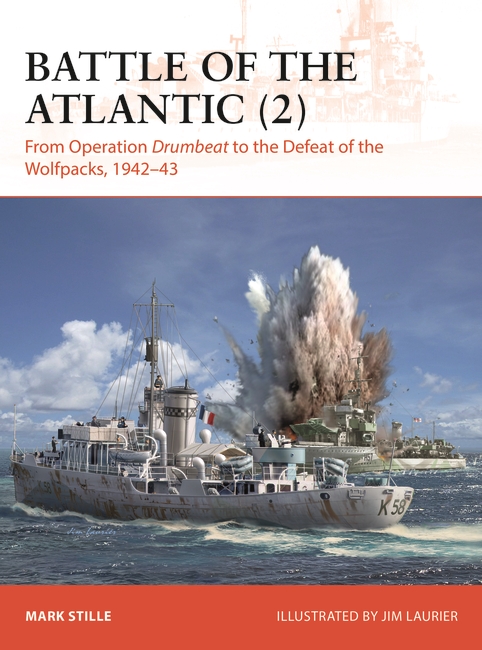
Battle of the Atlantic (2): From Operation Drumbeat to the Defeat of the Wolfpacks, 1942–43 covers the most dramatic and critical phases of the Atlantic campaign. When the United States entered the war, Admiral Dönitz, commander of the U-boat force, was quick to seize the opportunity to strike unprepared shipping off the US East Coast. The resulting massacre was a major defeat for the Allies and not until May 1942, when the United States Navy (USN) finally instituted convoys, did the disaster subside. For the remainder of 1942, Dönitz turned his attention to his primary concern: attacking convoys in the North Atlantic. The U-boats recorded considerable success against growing but still hard-pressed Allied convoy defenses. In March 1943, the U-boats gained their high-water mark against Allied shipping for the entire war. However, this was a chimera. Following the invasion of North Africa, the Allies were able to devote their full attention to the North Atlantic by employing very long-range (VLR) aircraft and escort carriers. The North Atlantic ‘air gap’ was closed and the U-boat savaged in May. This resulted in even Dönitz recognizing the full extent of this defeat and ordering a retreat from the North Atlantic on 23 May.
The events in the Atlantic of January 1942 until May 1943 make for a dramatic story. In this book, and every other account of the Atlantic campaign, the focus is on the convoys that came under attack (most convoys were not subjected to attack and thus their passage goes unmentioned). Losses to U-boats during the period covered by the book were impressive – 537 while in convoy, and 1,067 sailing independently or straggling from convoy. Allied losses figure prominently in all books covering the topic, and because they are the center of action, in this book as well. Nevertheless, these statistics miss the point; the Germans would win the Atlantic campaign by sinking more tonnage than the Allies were building. But despite the efforts of the U-boats, the war in the shipyards favoured the Allies. This trend was moving in favour of the Allies, and in July 1943 it reached a milestone: new construction of Allied merchant ships surpassed the total tonnage sunk by the Germans.
However, merchant ship losses do not tell the entire story. Between 1940 and 1943, dry cargo imports into Great Britain declined by 37 per cent from 41.9 million tons to 26.4 million tons. This was the result of U-boat operations, through the direct form of lost tonnage, the concurrent disruptions of shipping and the inherent inefficiency of convoying. Despite this apparent dramatic reduction, it failed to significantly impact Britain’s war economy. Overall imports remained about the same because of increased tanker exports, while substitution of material and an increase in domestic food production made up for other shortages. During the same period, output of war production increased significantly.
The establishment of an interlocking convoy system covering the western Atlantic was accomplished well after it should have been. Nevertheless, it proved extremely effective. From 1 July until 7 December 1942, a mere 39 ships out of 9,064 ships in western Atlantic convoys were lost. In the final three months of 1942, no losses to U-boats were recorded along the East Coast, the Gulf of Mexico or in the Panama Sea Frontier; only in the Caribbean did the U-boats gain any success.
For the escorts, the key to success was the level of training possessed by an escort group. Combat experience confirmed that this mattered much more than the number of escorts provided to a convoy or how modern the ships were. For example, convoy SC 118 had a maximum escort of 12 ships. Despite what appeared to be a strong escort, the group did not perform as well as the number suggested they should have. This demonstrated that prolonged convoy battles burned depth charges at a prodigious rate and the value of support groups to reinforced threatened convoys was made abundantly clear. In Admiral Max Horton’s (commander of the Western Approaches Command) words they were ‘vital to ensure reasonable safety’.
As seen by the Allies at the time, the convoy battles in the spring of 1943 constituted a full-blown crisis. In the first ten days of March, 41 merchants were lost in all areas; in the next ten, 54 more went down. Worse was that two-thirds were lost while in convoys, possibly imperiling the continuation of convoys themselves. As the situation began to look dire, things took a dramatic turn during the last 11 days of the month. Only ten ships were lost in the North Atlantic and an attempt by Dönitz to renew operations off the US East Coast and the Caribbean failed.
The seeds of German defeat were already in place, but had yet to make themselves felt. When they did, the fate of Dönitz’s North Atlantic campaign was laid to ruin. The advent of support groups, escort carriers and VLR aircraft translated into victory for the Allies. The Allies were aware that providing air cover to convoys throughout their entire transit was the key to victory. By the end of 1942, the Allies had the means to do this, but competing force allocation delayed the provision of air cover and gave the Germans extra months to extract heavy losses in the North Atlantic. By the end of 1942, 19 escort carriers were in service with the Royal Navy (RN) and USN. For the USN, it took until March 1943 to get their escort carriers deployed in the Atlantic. The RN took extra months to modify their US-built escort carriers to RN standards instead of deploying them as quickly as possible. The same problem affected the deployment of the most effective long-range escort aircraft, the American-built B-24 Liberator.
From January 1942 through May 1943, there were several identifiable phases in the campaign. From January to June 1942, only 49 merchants were lost to submarines while in convoys. Conversely, 504 ships were lost due to submarines sailing independently. The majority of these losses were recorded during the U-boat campaign off the US East Coast. In return, U-boat losses were low; 14 were lost while attacking convoys, and 22 to all other means.
The next phase of the campaign ran from July to December 1942.
German submarine deployments to the western Atlantic decreased and Dönitz began to focus on the North Atlantic and, consequently, the story began to change. The losses of ships while in convoy increased dramatically to 190 while the losses of independents decreased to 247. U-boat losses also began to increase; 47 were lost attacking convoys and 45 to all other Allied forces.
In 1943, Dönitz shifted his focus definitively to the North Atlantic. As a result, 172 ships were lost in convoys during the first five months of the year. The most important trend was the greatly expanded U-boat losses during the same period; 65 to convoy escorts, and 49 to other causes.
In the decisive months of April and May 1943, losses of U-boats increased dramatically to a total of 56. However, only 16 were solely attributable to surface escort ships. Escort ships, acting in conjunction with either shore or carrier-based aircraft, added another six. The balance was attributable to submarines, mines, accidents or were unknown. The effectiveness of convoys was demonstrated by the fact that only two ships were sunk in convoy while air cover was available.
At the end of 1943, the Admiralty looked back at the critical convoy battles of March and rendered an assessment that has been a staple of post-war books ever since. The analysis from the ‘Anti-Submarine Report’ of December 1943 made the statement that ‘the Germans never came so near to disrupting communications between the New World and the Old as in the first 20 days of March 1943’. This claim has been repeated in innumerable accounts of the campaign, including official British accounts. However, there is little evidence to support the claim that, in March 1943, the Germans were on the verge of victory or that the Allies faced imminent defeat.
By 1943, most trends in the campaign did not favour the Germans. U-boat losses were increasing, reaching 19 in February, 17 in March and 15 in April. With air cover now being available, U-boats were forced to dive and could not approach the convoy. Increased numbers of escorts, and particularly those assigned to the support groups, made it difficult for U-boat concentrations to operate near convoys. These factors made it difficult for Germany to sustain the growing ratio of ships sunk to U-boats lost.
Dönitz evidently saw the trends and what it meant for the success of the U-boat war. In April, he urged Hitler to approve another increase in U-boat construction so that losses would not cripple his operations. In a cognitive disconnect, Dönitz still believed he could gain a strategic victory just by building more of a slightly improved Type VIIC design. In this, he failed to fully comprehend the impossibility of conducting submarine warfare against well-developed defenses without a true submarine. German U-boats of the period were nothing more than submersibles, forced to dive whenever a threat emerged and then having to rely on their very slow and limited submerged speed. The full result of this massive disadvantage began to come into focus on the opening months of 1943 when Allied convoy defenses became more effective. Even in the successful SC 122/HX 229 battle, 16 of the 40 boats taking part had to return to port for substantial repairs. The combination of Allied technical innovation, Ultra intelligence and a massive shipbuilding program left the Germans without a path to victory in the next phase in the Atlantic campaign.
Comments
You must be logged in to comment on this post. Click here to log in.
Submit your comment