
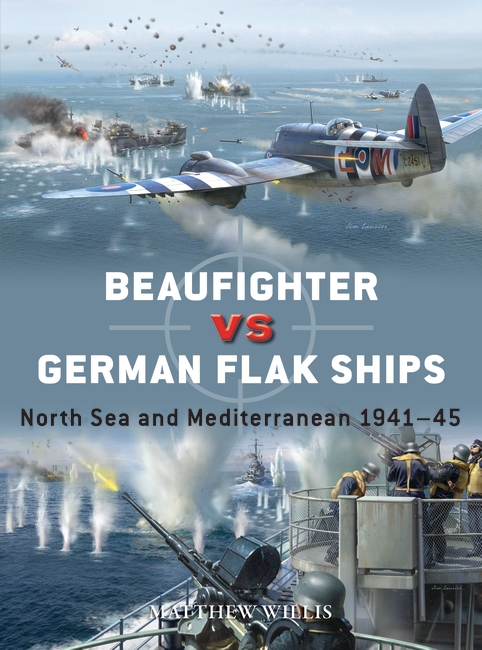
North Sea and Mediterranean 1941–45
The intriguing thing about the battle between RAF Bristol Beaufighters and Kriegsmarine ‘Flak Ships’ is that one of the combatants fell into the role somewhat by accident, and the other didn’t really exist – at least not in the form that its adversaries understood.
To cut a long story short, there was no such thing as a Kriegsmarine ‘Flak Ship’, which is to say there was never a specialist category of anti-aircraft escort vessel in the Kriegsmarine order of battle. What Allied airmen thought of as such were actually a range of vessels, all developed for other purposes, but which organically evolved to become fearsome adversaries to anti-shipping aircraft.
An additional irony is that the aircraft that became the biggest challenge to the putative Flak Ship was developed as a fighter and only gradually assumed its anti-shipping role while escorting strike aircraft – whereupon the type’s strengths in that field were recognised. It may, however, be no coincidence that the Beaufighter was derived from the Beaufort bomber, which was developed with an anti-shipping role in mind. By the climax of the war in Europe, the Beaufighter was the pre-eminent British maritime strike aircraft, although its zenith was already passing.
When World War II began, the RAF Coastal Command’s anti-shipping capability was in a parlous state. A handful of squadrons operated antiquated biplanes, and one of two modern monoplanes intended to replace them, the Blackburn Botha, quickly failed. The remaining aircraft, the Bristol Beaufort, was late, and not without its problems when it arrived. It was never available in great numbers, and the RAF attempted to bolster it with squadrons of Bristol Blenheims, as well as Lockheed Hudsons from the US.
These aircraft started to rack up successes against German shipping when restrictions on attacking merchant vessels were relaxed, although losses were severe, especially among the Blenheims. German auxiliary escort vessels, initially under-armed against enemy aircraft, were very quickly strengthened with ever-increasing numbers of modern anti-aircraft ‘Flak’ guns in a range of calibres, crewed by skilled Kriegsmarine gunners. The battle in the North Sea intensified as German shipping transported vital metal ores from Scandinavia.
The vessels that RAF crews described as ‘Flak Ships’ tended to fall into one of two categories. The smaller of the two was the Vorpostenboot (VPB), or patrol vessel (literally ‘outpost boat’), of which most were converted trawlers – although these were later superseded by dedicated VPBs based on trawler designs. The larger was the Sperrbrecher (literally ‘barrage breaker’), a vessel that had no direct analogue in Allied navies, but which was essentially a merchant-ship-based auxiliary escort developed to clear mines from the path of other vessels. Some Sperrbrecher later used sophisticated electrical equipment to detonate magnetic mines at a distance, but in essence, the vessel was a battering ram designed to clear mines by washing them aside in its bow wave or even detonating them against its reinforced hulls.
As the danger from surface vessels, submarines and mines was matched and then exceeded by the risk from aircraft, these escorts’ armament and weaponry evolved to meet the new threat. Increasing numbers of escort vessels were assigned to convoys, surrounding the vital cargo ships with a ring of steel.
But the RAF was not standing still either, and their response to the Kriegsmarine’s new measures came from an unexpected direction.
In the lead-up to war, the RAF was desperate to introduce a fighter armed with the new generation of larger-calibre autocannon, such as the 20mm Oerlikon FF or Hispano HS.404, to counter the expected waves of German bombers. The Air Ministry favoured a twin-engined aircraft with cannon in its fuselage, as the potential effects of recoil on wing-mounted guns were unclear. The preferred Westland Whirlwind was experiencing a troubled development, so when Bristol offered a makeshift cannon fighter that could be introduced relatively quickly, the Air Ministry was interested. Bristol suggested that the wing and tail from its Beaufort reconnaissance and torpedo bomber could be mated to a new, smaller fuselage and larger Hercules engines to produce a heavy fighter. It would be large by fighter standards but that wasn’t a major concern if its job was to knock down unescorted bombers. Bristol suggested a maximum speed of 370mph, which would help to offset its relative lack of agility.
As it turned out, this estimate was hugely optimistic, and the Beaufighter, as it was soon named, never got much above 300mph. Still, by the time this was apparent, the aircraft’s role had changed again. The threat from daytime bombing was over by the autumn of 1940, just as the Beaufighter was approaching squadron service, but a new danger in the form of night bombing made the aircraft attractive due to its ability to carry airborne interception radar, while its top speed remained adequate.
RAF Coastal Command also had its eye on the Beaufighter. There was space in its airframe for more fuel, and it could carry a navigator, allowing the aircraft to act as a long-range maritime fighter for countering the Luftwaffe bombers and patrol aircraft that threatened British shipping.
It was in the Mediterranean, however, that the Beaufighter’s anti-shipping credentials were borne out. Axis shipping was just as well protected by Flak there as in the North Sea, and AA guns proved a greater threat than enemy aircraft. Therefore, the Beaufighters escorting anti-shipping aircraft made themselves useful, initially by strafing the escort vessels with their 20mm cannon, and then by dropping bombs.
By 1942 the Beaufort was overdue for replacement, but there was no new aircraft on the horizon. The Air Ministry asked for an uprated Beaufort with Beaufighter powerplants. Instead, Bristol suggested that the better solution was to modify the Beaufighter to do the same job. It was quickly proved that it could carry a torpedo, and the new series of Beaufighter ‘torpedo fighters’ was born. Moreover, new weapons were emerging, including the rocket projectile with a range of different warheads.
The Beaufighter was significantly faster and, crucially, more manoeuvrable than the aircraft it replaced in the anti-shipping role. The wing turned out to be strong enough both to withstand violent manoeuvres at low level, and to hang bombs and rockets on. In 1943, Coastal Command formed several strike wings, each comprising two or three expanded squadrons, to harry German shipping all along the coasts of occupied Europe, from the English Channel to the north of Norway.
The numbers of ships sunk or damaged rose dramatically, prompting the Kriegsmarine to deploy even stronger escorts armed with even more weapons. The strike wings found that armour-piercing warheads on their rocket projectiles could tear open the hull of a transport or escort along much of its length, while high-explosive warheads could decimate the relatively unprotected Flak crews. Eventually, torpedoes were largely dispensed with in favour of rockets.
While the Beaufighters were undoubtedly taking a toll on German shipping in the last year of the European war, the reverse was also true. The loss rate rivalled that of Bomber Command. A particularly devastating operation in February 1945 became known as Black Friday. An attempt to attack a damaged German destroyer in Førde Fjord led to nine Beaufighters being shot down – seven by Flak from the destroyer and her auxiliary escorts, while two were shot down by fighters. None of the ships were sunk.
The Beaufighter had reached the peak of its development, and faster, more manoeuvrable aircraft such as the de Havilland Mosquito were needed. Bristol was developing its own successor, the Brigand, but this would miss the end of the war. Ultimately, Germany was defeated, partly through the strangulation of its supply routes, including the coastal convoys, but chiefly through direct assault. Many of the vessels and crews that had supported the German coastal shipping convoys were put to more peaceful work after the war, clearing the thousands of mines that littered the North Sea. The Beaufighter quickly disappeared from Coastal Command following the end of the European War, although a few aircraft were adapted for target-towing. Three of the eight surviving complete Beaufighters are Coastal Command anti-shipping variants.
You can find out more in DUE 151 Beaufighter vs German Flak Ships.
Comments
You must be logged in to comment on this post. Click here to log in.
Submit your comment