
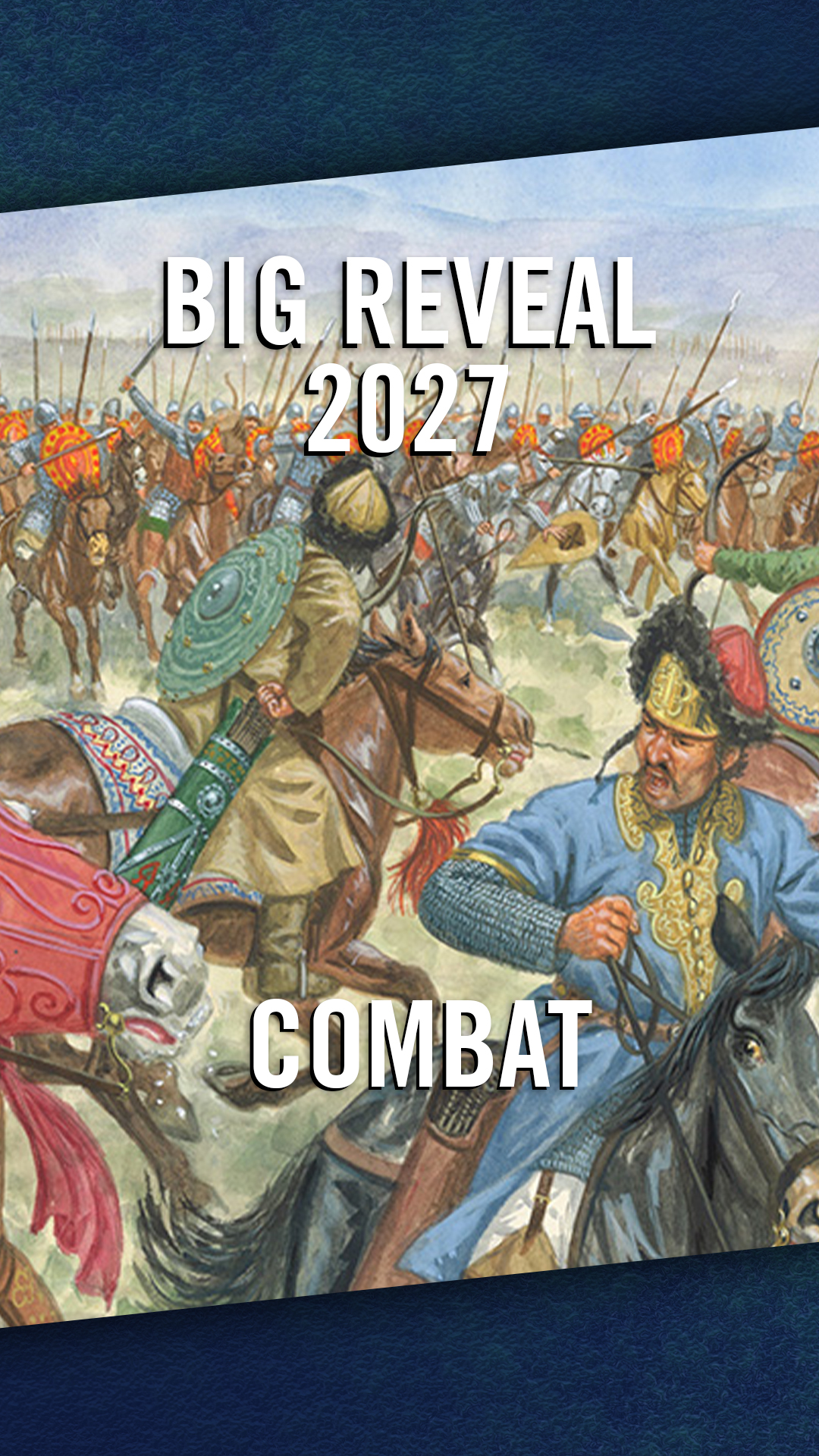
Find out what you can expect from the Combat series in 2027!
CBT 88 Desert Rat vs Afrikakorps Soldier: Operation Crusader 1941
By David Greentree
Illustrated by Steve Noon
18/02/2027
Fully illustrated, this study assesses the importance of British and German infantry formations to the armies fighting in Operation Crusader during late 1941.
During the Desert War (1940–43), both sides viewed armour as the decisive arm because the North African terrain did not hinder its manoeuvrability. Having defeated the Italians in 1940, the British believed their infantry did not need to co-operate with tanks, enemy tanks did not need to be targeted offensively by anti-tank guns, and tanks and artillery could be dispersed.
When Rommel’s Deutsches Afrikakorps arrived, however, the British were rudely awakened. If infantry units lost armour support, they risked suffering crippling losses from enemy tanks. The British tended to keep their tank units close to infantry to counter German armour, meaning they were not available to the same extent as German armour to exploit battlefield successes.
In this book, David Greentree investigates the effectiveness of the two sides’ motorized infantry during Operation Crusader, the Allied bid to relieve the besieged port of Tobruk in late 1941. He focuses on three moments in the fighting: the British attack on 21 November; the German counter-attack on 22 November; and the struggle for Belhamed on 1–2 December. Featuring specially commissioned artwork and mapping and carefully chosen archive photographs, this is the story of motorized infantry at war in late 1941.
CBT 89 Japanese Soldier vs US Marine: Iwo Jima and Okinawa 1945
By Gregg Adams
Illustrated by Johnny Shumate
22/07/2027
This fully illustrated study investigates the American and Japanese fighting men who confronted one another on Iwo Jima and Okinawa in 1945
.In 1945, as the Imperial Japanese Army faced the prospect of shattering defeat, the US Marine Corps won immortal fame for its valor, first on Iwo Jima and then on Okinawa. Featuring carefully chosen photographs, specially drawn maps, and full-color original artwork, this absorbing account casts light on the combatants on both sides in these bloody island battles, as World War II moved toward its grim climax.
The five-week battle for Iwo Jima (February and March 1945) was characterized by extraordinarily bloody fighting, with the Japanese manning formidable fortifications and their US opponents deploying awesome firepower and complete air superiority. Uniquely, Iwo Jima saw American casualties exceed those of their opponents; only 216 Japanese were captured out of a total garrison of 21,000. The Okinawa operations (April–June 1945) involved the largest amphibious landing in the Pacific and resulted in 150,000 combatant casualties, as well as a comparable number of civilian fatalities.
In this study, Gregg Adams examines the US Marines involved in these battles alongside their Japanese opponents. He considers US and Japanese combat doctrine, organization, weaponry, and tactics in the Iwo Jima and Okinawa fighting, as the noose tightened around Japan and Allied victory became inevitable.
CBT 90 US Doughboy vs German Soldier: Meuse–Argonne 1918
By Gregg Adams
Illustrated by Adam Hook
19/08/2027
Fully illustrated, this volume examines the American and German fighting men who confronted one another in the closing weeks of World War I.
The largest and also the deadliest campaign in the US Army’s history, the Meuse-Argonne offensive of September–November 1918 was part of the Allied Powers’ Hundred Days Offensive, as they strove to eject German forces from France and win World War I. For their part, the exhausted and demoralized German forces facing the Americans sought to hold their ground in the face of overwhelming firepower and formidable American troop numbers. The ensuing fighting lasted more than six weeks and resulted in over 350,000 casualties.
In this study, Gregg Adams examines the US soldiers caught up in these climactic battles alongside their dogged opponents of the Imperial German Army. He assesses both sides’ combat doctrine, organization, weaponry, and tactics in the Meuse-Argonne operations, as the American Expeditionary Forces sought to pierce Germany’s formidable Hindenburg Line, advance into German territory, and compel the Kaiser’s forces to surrender. The insightful text is accompanied by a wealth of archive photographs, full-color maps, and specially commissioned battlescene artwork.
CBT 86 Roman Legionary vs Hellenistic Phalangite: Italy and Greece 280–168 BC
By Murray Dahm
Illustrated by Giuseppe Rava
28/10/2027
This fully illustrated study examines the clashes between the Roman legion and the Hellenistic phalanx in the 3rd and 2nd centuries BC.
Following Alexander the Great’s death in 323 BC, his generals and their successors harnessed the formidable power of the Macedonian phalanx to carve up his empire into realms of their own. Meanwhile, Rome emerged as one of Italy’s most powerful cities, with the manipular legion at the forefront of its efforts to forge a wider empire.
In this book, Murray Dahm assesses the fighting men at the heart of these two civilizations’ military prowess, the phalangite and the legionary. He charts their clashes on three bloody battlefields, showing how the two sides’ strengths and limitations shaped their decades-long struggle for supremacy.
At Heraclea (280 BC), the army of Pyrrhus of Epirus confronted Roman forces for the first time in a gruelling clash that left both sides reeling. At Cynoscephalae (197 BC), a Macedonian army fought two Roman legions and their allies in a momentous battle that ended the Second Macedonian War. At Pydna (168 BC), legionaries faced phalangites in a decisive encounter that confirmed the eclipse of the phalanx and the formidable power of the legion.
Featuring specially commissioned artwork and mapping, this absorbing account casts light on the evolving contest between two competing military systems in a series of battles that shaped the fate of the Ancient World.
CBT 91 Royal Marines Commando vs Taliban Fighter: Afghanistan 2007–11
By John Rawlinson
Illustrated by Johnny Shumate
25/11/2027
This book pits Britain’s elite Royal Marines Commandos against the Taliban in three gruelling encounters during Operation Herrick, the British involvement in Afghanistan in 2002–14.
During Operation Herrick, the Royal Marines Commandos provided a vital element of British forces engaged in combat operations in Afghanistan, deploying on 12 occasions at unit strength and many more times attached to other formations. Their opponents during this effort were the Taliban, an Afghan political and militant movement intent on retaining its grip on power in Afghanistan. In this book, Royal Marines insider John Rawlinson casts new light on the fighting men on both sides during this drawn-out confrontation. With operations across a vast geographical area and many different types of terrain and both sides’ evolving strategy and tactics leading to the deployment of new weapons and kit, the campaign provides fertile ground for military study.
This account looks in detail at three sub-unit actions that cast light on the two sides’ evolving tactics. Described here in detail, these scenarios provide an opportunity to study not only evolving Commando tactics but also the Taliban response: retreat and disrupt, fight hard or melt away to insurgency. The insightful text is accompanied by a wealth of rare photographs, full-colour mapping and specially commissioned battlescene artwork.
The next post will be Fleet on Friday 14th August.
Comments
You must be logged in to comment on this post. Click here to log in.
Submit your comment