
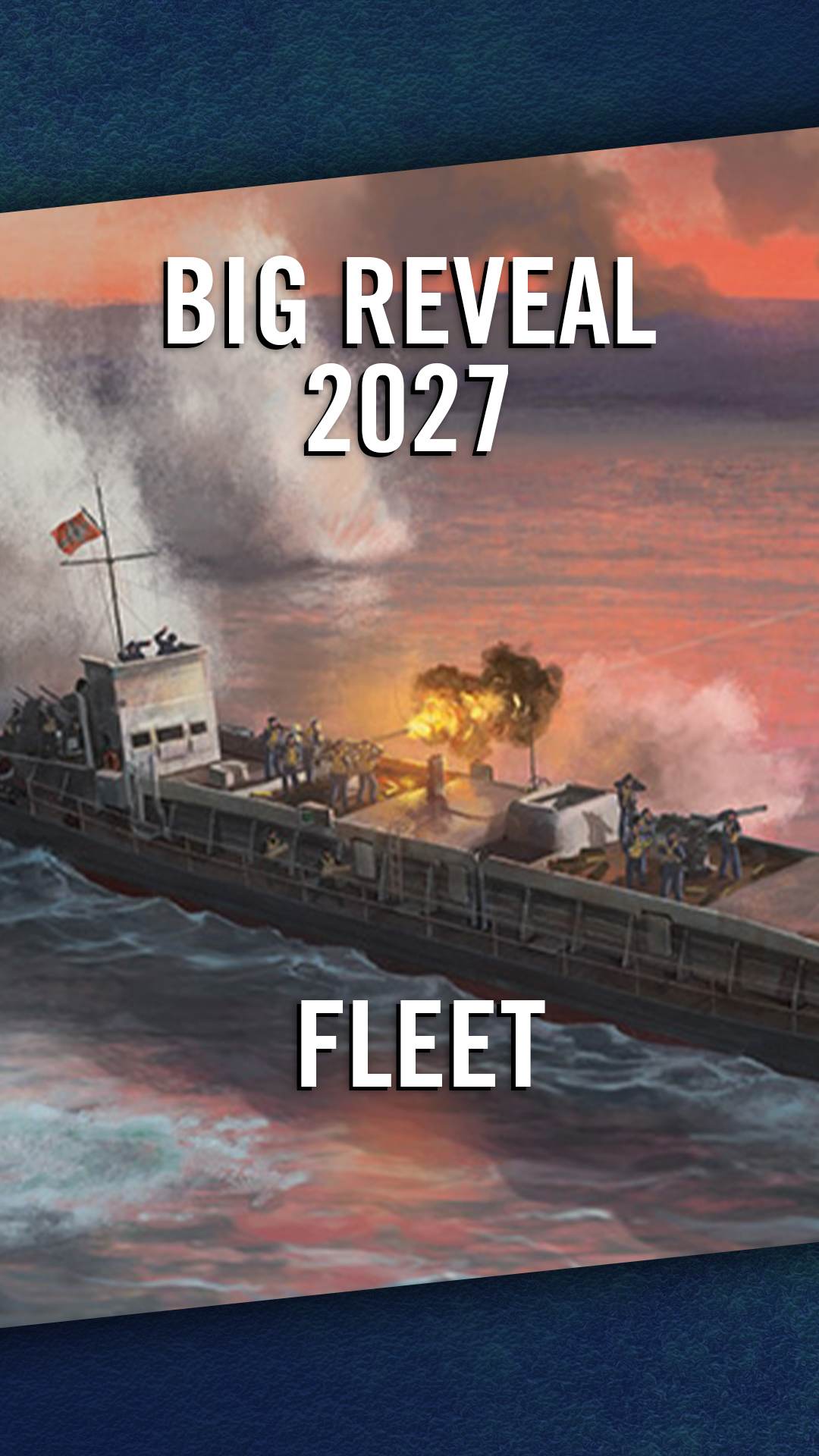
As well as four titles exploring major aspects of World War II from the North Sea to the Pacific, this year’s Fleet list also delves into modern sea power, with two books on Soviet and British fleets of the Cold War, as well as a welcome addition to the series’ coverage of the age of sail.
FLT 24 US Navy Pacific Fleet 1942–43: Guadalcanal to the Solomons
By Mark Stille
Illustrated by Adam Tooby
21/01/2027
The savage naval battles of Guadalcanal, New Guinea and the Solomons were transformative for the US Navy. Fully illustrated, this analyses the fleet’s capabilities and combat in this period.
The naval battles of 1942–43 around Guadalcanal and in the Solomons were some of the fiercest and most closely contested of the Pacific War. The campaigns included most of the surface actions of the war, as well as two carrier battles, three major amphibious landings, and a submarine offensive. Fighting by day and night against the superbly trained Japanese, they tested the Pacific Fleet’s warfighting capabilities to the utmost.
In this book, renowned US Navy historian Mark Stille presents a distilled guide to the detail of the Pacific Fleet of 1942–43, the period that saw its biggest transformation in terms of equipment, doctrine, and capability. America’s huge naval construction effort began to feed through to the front line, while the fleet made advances in its previously deficient surface, air, and submarine warfare doctrine and tactics. The Pacific Fleet also learned how to support large forces far from established bases.
Packed with superb original artwork, maps, and archive photographs, this book explores the warships, weaponry, organization, intelligence, logistics and battles of the Pacific Fleet, as it fought to gain the upper hand in the South Pacific.
FLT 25 Royal Navy Task Force Falklands 1982: Modern sea power in combat
By Robert Brown
Illustrated by Edouard A. Groult
18/03/2027
Illustrated throughout, this is an essential guide to all aspects of the Royal Navy fleet that won the Falklands War, the fiercest naval war of modern times.
In 1982, a unique naval campaign was fought in the South Atlantic. The only war to be fought in the open ocean since World War II, the Falklands War pitted two adversaries in a remarkably closely fought campaign. The Royal Navy was among the world’s most advanced, but it was fighting nearly 8,000 miles from home and with little in reserve. Although a second-tier power, the Argentinians had the advantage of fighting close to home, and an array of modern weaponry with devastating potential.
In this book, naval historian Robert Brown dissects the Royal Navy task force that fought and won in the Falklands. Researched from an array of primary sources, he reassesses all aspects of the fleet’s capabilities, how it was organized and led, and what made this far-flung campaign possible. He examines the tactics that the Royal Navy devised to take on the Argentinian Navy and Air Force, and how the campaign was fought, including highlighting some of the lesser-known actions of the naval war.
Superbly illustrated throughout, with dramatic new artwork of key moments in the campaign, 3D diagrams, maps and archive photos, this is a timely examination of perhaps the Royal Navy’s last great expeditionary fleet.
FLT 26 Kriegsmarine Task Force Norway 1940: The Weserübung amphibious invasion fleet
By Lawrence Paterson
Illustrated by Adam Tooby
27/05/2027
Fully illustrated throughout, this is the first book to focus on the Kriegsmarine’s role in the invasion of Norway, Germany’s only major amphibious invasion of the war.
The invasion of Denmark and Norway saw the Kriegsmarine’s most extensive deployment of focused naval power of the entire war. Although truly a combined services invasion, the Kriegsmarine was the only means by which to make multiple coordinated landings on a hostile and frequently inhospitable coastline that stretched for over 2,500km.
Yet as Kreigsmarine historian Lawrence Paterson explains, this was a feat undertaken by a navy not designed for such operations. He examines the extensive preparations needed to assemble a dedicated task force to land large army formations, while also providing covering fire for landings, minesweeping support, escorts capable of engaging major warships, anti-submarine patrols and – perhaps most importantly – supply of beachheads that were remarkably isolated from each other. The task force’s purpose was complex and interwoven; an amphibious operation on a scale that the German military had never before undertaken, and never would be capable of again.
Superbly illustrated throughout with maps, diagrams, archive photos – some previously unpublished – and original artwork, this is the story of the Kriegsmarine’s most ambitious single operation, and its pyrrhic victory.
FLT 27 US Navy in the War of 1812: The young republic's mighty frigate fleet
By Matthew Norton
Illustrated by Edouard A. Groult
24/06/2027
A lavishly illustrated history of the fleet that fought the United States’ first major naval conflict, the War of 1812 against the British.
Famed for the duels its powerful frigates fought with the Royal Navy – then the world’s mightiest naval power – the War of 1812 was the making of the US Navy.
In this book, maritime historian Matthew R. Norton presents a concise, illustrated history of the development and composition of the 1812 fleet, from the famous 44-gun frigates, arguably the world’s finest at the time, to the Jeffersonian gunboats and the Great Lakes fleet. He explores the technical innovations of the fleet, its organization, shipbuilding, manning, and command, and the combat that US Navy ships saw around half the world, from the English Channel to the Pacific Ocean. He also assesses the difficulties the fleet faced and how well the Navy’s strategy achieved the United States’ war aims, and whether alternative strategies could have performed better.
Illustrated throughout with superb original artwork, maps, and 3D diagrams, as well as period paintings and engravings, this examines the US Navy’s first trial by fire.
FLT 28 Soviet High Seas Fleet 1962–91: The Cold War on the world's oceans
By Alexander Hill
Illustrated by Adam Tooby
22/07/2027
An expert, illustrated history of how the Soviet Navy transformed itself into a global force, and its effects on Cold War history.
In the aftermath of the humiliation of the Cuban Missile Crisis, the Soviet Navy sought to transform its capabilities to project seapower globally. Over the next three decades, the Soviet ocean-going fleet would take on the US Navy in a high-stakes confrontation over the Yom Kippur War, use its maritime muscle to support allies around the world, and its spy ships and aircraft would gather intelligence on the West’s navies, from NATO exercises to the Falklands task force.
In this book, Professor Alexander Hill, a specialist on Soviet military history, examines the development of the Soviet Union’s bluewater fleet, including submarines, surface combatants, and helicopter and aircraft carriers, and the technology behind them. He explores the USSR’s strategic imperatives, the naval exercises that honed the fleets, and how both logistical needs and foreign policy objectives led to the Soviets’ acquisition of naval bases around the world, from Cuba to Angola and Vietnam.
Illustrated with archive photos, superb new artwork, maps and diagrams, this book reveals the secret history of how the Cold War was fought at sea.
FLT 29 Royal Navy Mediterranean Fleet 1940–42: Britain’s battle against the odds
By Angus Konstam
Illustrated by Edouard A. Groult
19/08/2027
A fully illustrated study of the Royal Navy’s most prestigious fleet, in the crucial years when it fought to turn the tide against Axis dominance of the Mediterranean.
The Mediterranean Fleet had long been among the Royal Navy’s most prestigious and powerful, charged with securing Britain’s trade links and military power throughout the Mediterranean, and to the Suez Canal and India. However, World War II would be a war in which that supremacy was seriously threatened, by the powerful new Italian and German naval forces and especially by land-based Axis air power.
In this book, naval historian Angus Konstam explains how the Mediterranean Fleet’s professionalism and training initially secured the advantage, crippling the Italian battlefleet in a carrier raid on Taranto, followed by victory at sea at Cape Matapan. However the following two years were fought against the odds, with German and Italian aircraft making forays into the Central Mediterranean prohibitively costly, and the Axis' invasion of Greece and attacks on Malta putting the fleet on the back foot.
Superbly illustrated throughout with original artwork, maps, 3D diagrams, and archive photography, this book explores perhaps the most challenging theatre for British sea power in World War II, and how it survived to eventually turn the tide.
FLT 30 Japanese Combined Fleet 1943–45: The destruction of the IJN
By Mark Stille
30/09/2027
A fully illustrated survey of how the IJN Combined Fleet prepared for and fought the great naval battles of 1944, which would end in its obliteration.
Following its defeat in the Solomons campaign, and in preparation for the expected American invasions in the Central Pacific, the Imperial Japanese Navy’s main force, the Combined Fleet, underwent a major reorganization. Over the next year, it would attempt to fight two ‘decisive’ battles to turn the tide of the war, but the battles of the Philippine Sea and Leyte Gulf would finish the IJN as a fighting force.
In this book, Pacific War historian Mark Stille examines the fleet that fought Japan’s last major naval battles. He outlines how Japan’s remaining strength in warships and equipment compared to that of the early war, highlights how severe problems in intelligence and logistics hampered the IJN’s offensive efforts, analyses the major battles fought, and explains how the IJN was finally forced onto the defensive to prepare for an invasion of the homeland.
Packed with archive photos, superb original artwork and maps, this is a complete portrait of the IJN’s last major fleet, as it faced its doom in 1944.
The next post will be the Men-at-Arms Big Reveal on Friday 21st August.
Comments
You must be logged in to comment on this post. Click here to log in.
Submit your comment