
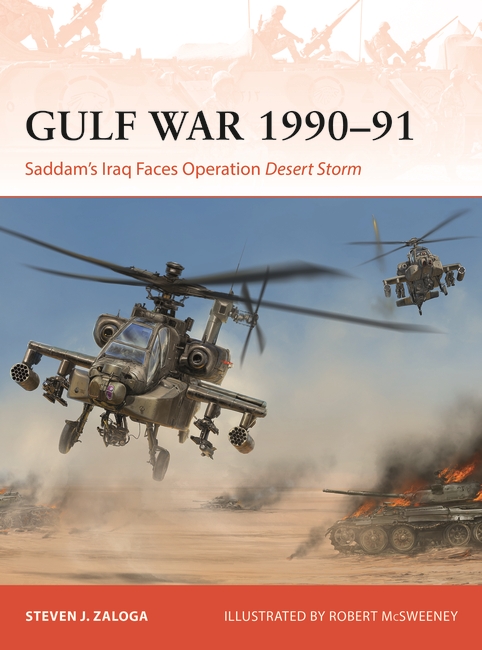
I had been pushing my editors at Osprey to do a Campaign title on the 1990–91 Gulf War for a number of years. At last, in 2024, Osprey agreed. This subject interested me more than many other titles since I had a more personal connection to the conflict than any of the other historical events I had written about.
Back in 1990, at the start of the Gulf War, I was a writer/director for Video Ordnance Inc., a New York-based TV production house. We were doing a TV series called Firepower for The Discovery Channel that was widely syndicated in about 35 countries. This series dealt with contemporary military technology. Some of our clients expressed interest in some sort of program on the events in the Middle East, so we arranged a trip to Saudi Arabia to tape interviews and conduct video-taping. We arrived in Dhahran during Operation Desert Shield, prior to the outbreak of the war. Some of the photos I took at the time ended up in the new Osprey book.
After returning to the US, I was hired as a consultant by PBS in New York to help them set up interviews with the US Department of Defense for the MacNeil/Lehrer NewsHour nightly news broadcast. When the war finally broke out, the US Department of Defense directed that no military personnel would be allowed to appear on TV for the duration of the war. So suddenly I changed roles from background organizational work to appearing nightly on nationwide TV as a “talking head.” One of the side benefits of this activity was that I got to view the entirety of the daily TV pool video-feed covering the war.
At the conclusion of the war, Video Ordnance decided to do a series of programs related to Operation Desert Storm. Our video crew traveled to various military bases. I was able to interview many officers who took part in the war, and to collect a lot of documentary material that eventually helped in the preparation of this book. We did several programs for the Firepower series on Operation Desert Storm, as well as a standalone documentary for the A&E Network.
There were some advantages to waiting 30 years to do this book. A great deal of additional material had been published in the interim. This was especially the case regarding resources about the Iraqi side of the story. The US Department of Defense collected many Iraqi records on military planning and operations, and some of this ended up as studies by the Institute for Defense Analyses, a federal think-tank. Besides the new Iraqi material, numerous official histories had been published. This formed the core of the documentation I used to prepare the Osprey Campaign title. One of the challenges was to cram so much material into such a small format! Overall, I think that my own experiences and the wealth of new published material helped to create a book with a fresh look at this conflict.
You can read more in Gulf War 1990–91: Saddam's Iraq Faces Operation Desert Storm
Comments
You must be logged in to comment on this post. Click here to log in.
Submit your comment