
Popular perceptions of the combat by the 101st Airborne Division during the Normandy campaign are heavily shaped by the dominating mythos of the Band of Brothers TV series. This book avoids the obsessive focus on Lt. Dick Winters and his company. Instead, it takes a broader perspective on the missions of the 101st Airborne Division in the days after D-Day.
Allied planning had presumed that Utah Beach and Omaha Beach would quickly link up after D-Day, forming a solid front against German counterattacks. This did not happen, and US Army commanders worried that the delay gave the Germans an opportunity to frustrate American operations in Normandy. The 101st Airborne Division was given the task of fighting its way eastward to link the two invasion beaches. The primary tactical objective in this mission was the small Norman town of Carentan that controlled the road network from Utah Beach to Omaha Beach. This mission was greatly complicated by German pre-invasion schemes to flood the farmland behind Utah Beach to slow the expansion of the American beached. As a result, the fighting on the approaches to Carentan was shaped by the water-soaked topography.
The main opponent of the 101st Airborne Division was the Fallschirmjäger-Regiment.6 from the Luftwaffe’s elite paratrooper force. On paper, the 101st Airborne Division substantially outnumbered the elite German paratroopers. But the 101st Airborne Division had lost so many men during the chaos of the airborne drops that the contest was much more even. For nearly a week, the two paratrooper forces battled for control of Carentan. The 101st Airborne Division finally wrested control of Carentan from the German paratroopers, only to be faced by a counterattack by the newly arrived 17.SS-Panzergrenadier Division. The turning point came when Allied cryptographers intercepted German Enigma messages that revealed the German plans. As the SS troops advanced on the outnumbered American paratroopers, Sherman tanks from the 2nd Armored Division arrived to save the day. This final encounter firmly linked Utah and Omaha Beaches, cementing the Allied control of the D-Day landings.
This book is based on extensive archival research and is the first to include an account balanced by coverage of the fighting from the German perspective.

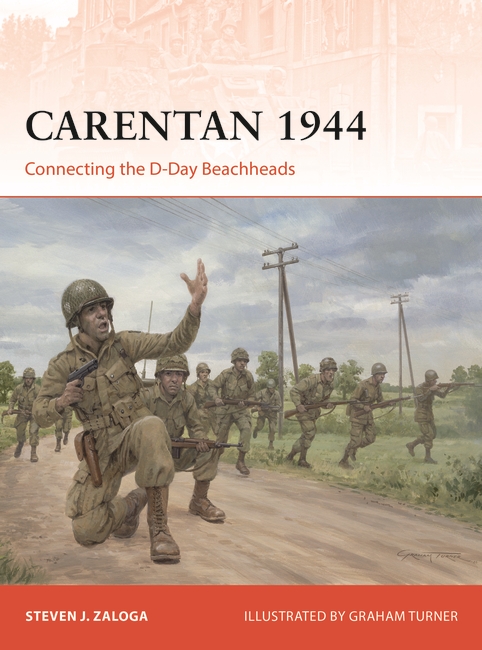
THE PARATROOPER CHARGE AT THE CARENTAN CAUSEWAY, JUNE 11, 1944
On the morning of June 11, Lt. Col. Robert Cole had his depleted 3rd Battalion, 502nd PIR, deployed near Bridge No. 4 at the southern end of the Carentan causeway near the Pommenauque suburb of Carentan. His troops were under continual small-arms and mortar fire by entrenched troops of the FJR.6, centered around the Férme Pommenauque, also known as the Ingouf farm. To overcome the German defenses, Cole requested that supporting artillery douse the farm complex with smoke rounds. He instructed his troops to fix bayonets and prepare to charge the farm once the smoke had sufficiently obscured the approaches. At 0615hrs, Cole blew his whistle and charged forward out of the ditch, armed with a .45 cal pistol. He was followed by his radioman, T/5 Robert Doran, equipped with an SCR-300 walkie-talkie FM radio. Due to confusion over the plans, at first only about 20 men followed Cole. He continued to run toward the farm, firing his .45 cal pistol. Eventually, more troops followed, prodded on by his example as well as by his executive officer, Maj. John Stopka. The charge eventually included about 100 paratroopers, who managed to overwhelm the positions of the 11./FJR.6 holding the farm.
The paratroopers are armed primarily with the M1 Garand rifle, the same weapon used by regular US Army infantry units. Some paratroopers were issued the M1A1 carbine. This was a specialized version of the carbine with a folding stock to make it easier to be stowed for airborne drops. The paratroopers had a different uniform than regular US infantry or the glider infantry of the 101st Airborne Division. It was distinguished by additional pockets to carry the paratrooper’s gear. Prior to the Normandy air landings, the battledress was impregnated with a type of wax coating intended to seal it against the possible German use of chemical weapons. The paratroopers were also issued with a different version of the standard M1 helmet that had reinforced straps and a leather chin cup to ensure it remained in place during the parachute drop. The battalions of the 101st Airborne Division adopted special insignia painted on the side of their helmets, in this case a heart. Paratroopers were also authorized to wear Corcoran leather jump boots that offered better ankle protection during landing.
Illustrated by Graham Turner.
Read more in CAM 437 Carentan 1944: Connecting the D-Day Beachheads.
Comments
You must be logged in to comment on this post. Click here to log in.
Submit your comment