
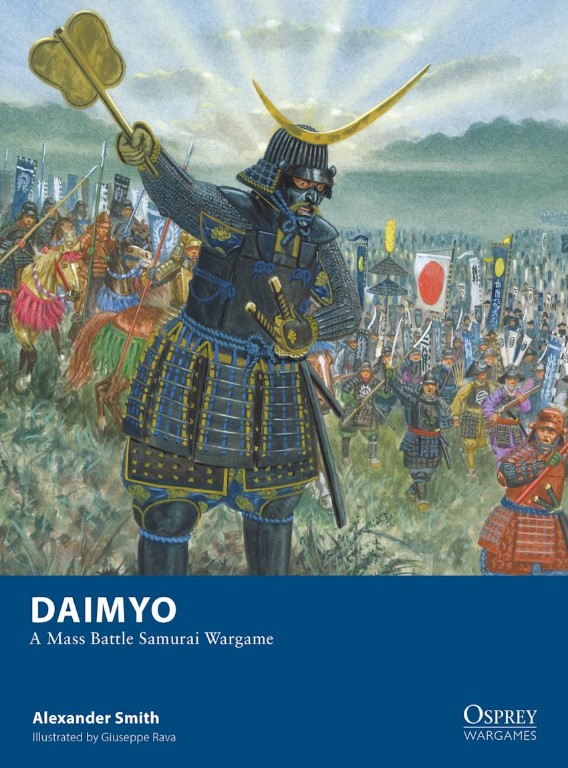
Daimyo is a set of fast-play, mass battle wargames rules set during Japan's Sengoku period. This week author Alexander Smith explores how players control their armies on the table.
*************************************************************
Friction
Friction, how easy or difficult it is for a player to control their forces, is one of the key issues every ruleset needs to address. For the Sengoku Jiadai period, finding the right friction balance can be a tricky proposition.
On one hand, the armies of the period were feudal in nature, with each lord leading their household troops along with that of their vassals. This could, at times, lead to disjointed command and control, with proud clan-leaders making independent decisions or failing to cooperate with one another.
On the other hand, decades of continuous warfare had developed the command system of most daimyo into a fine art. From their jinmaku command tent, the daimyo could direct tens of thousands of soldiers using a sophisticated system of flags, drums, and messengers.
Daimyo strives to put players in the sandals of their general, with the power and limitations that come with it. This is done through the use of a unique order token system.
Activation
In Daimyo, each army is subdivided into two or more sonae (the equivalent of a brigade), which has a numbered token associated with it called a commander token. The commander token of all sonae on both sides are added to a bag or other opaque container at the beginning of each turn. When a commander token is drawn from the bag, the associated sonae and all of its constituent units may activate. Once all sonae have activated, the turn ends and the tokens are returned to the bag for the next turn. The result is that players can never be sure in which order their sonae will activate!

Order System
Furthermore, each player also receives a number of order tokens (of which there are four types: march, fire, charge, and reform). The order tokens represent the messengers or signals that a daimyo sends out to his subordinates with instructions. Each commander token also acts as a “wild card” order token, allowing that sonae to undertake a single order - this represents the local commander utilizing their own initiative. Players can then add additional order tokens from their order pool to give the sonae additional actions.
For example, a player wishes to get his Teppo Ashigaru into range to open fire on an enemy unit. Once the commander token is drawn, he could use that commander token to march once towards the enemy, and decides to also add an additional march and fire order from his order pool. Now, the units of the sonae can march twice, to get into close range before opening fire.
However, order tokens are a limited resource. At the end of each turn, all the spent order tokens go into the bag along with the commander tokens and are only returned to the controlling player when drawn from the bag in subsequent turns. This temporary loss of order tokens represents messengers being waylaid, wounded, or delayed. Players will need to be prudent about how they spend their order tokens, lest they find themselves with diminished control over their army when the critical moment arrives!

Special Orders
Aside from the four standard orders, each clan also has their own Special Order which gives them unique or enhanced abilities when used. Special Orders require a combination of two specific order tokens, so should be used sparingly, but can tip the balance of the battle when used at the right moment.
For example, the Takeda clan has the Special Order “Thunderous Cavalry Charge” which upgrades their cavalry for the turn, giving them the Fearsome ability which reduces the morale dice of their opponents in melee combat.

*************************************************************
Daimyo is available July & is available to pre-order now.
Get your miniatures ready for Daimyo with our guide to basing and unit composition.
Find all the gaming resources you need as free downloads here.

Comments
You must be logged in to comment on this post. Click here to log in.
Submit your comment