
Introduction
The background story to MAA 569 (Armies in North Russia and Siberia 1918–20), scheduled for publication in May 2026, is that of a chance discovery, with unexpected and far-researching implications. It is the story I would like to share with Osprey’s readership, in the hope that it will spark their interest in this work.
During my research into my earlier Osprey Work on the Allied interventions in Southern Russia (MAA 540), I first became aware of a parallel Allied intervention that unfolded, at roughly the same time, thousands of kilometres away, in North Russia, Siberia and the Russian Far East. Having expected my research to take me no further than the Black Sea and the North Caucasus, I soon found myself travelling further afield, to an entirely different theatre of operations and to a no less interesting intervention, one that was, in many ways, even more remarkable than the one I had been spending time on!
An unlikely encounter
During the course of my research into MAA 540, I came across photographic material and reports describing how American troops, serving as part of an Allied expeditionary force (hitherto unknown to me), found themselves deployed on Russian territory, equipped with Russian-made personal weapons and confronting Russian soldiers! The realization that US troops, in particular, had set foot on Russian soil, on a high-stakes combat mission, turned on their head many of the received narratives I had been familiar with, not only about the aftermath of World War I but, also, about US foreign policy before the 1940s. The idea that American troops were fighting – or, at the very least, facing off against – Russians, using Russian arms, in the vast expanses of North Russia and Siberia struck me as both fascinating and bizarre. Apart from highlighting a little known chapter of post-World War I history, which deserved more attention, it also underscored how fragmented and chaotic the Russian Civil War truly was, while at the same time raising questions about logistics, geopolitics, and the improvisations forced upon soldiers on the ground.
It soon became clear to me that the Siberian theatre was not merely an extension of the Southern Russia campaign: it had its very own dynamics, its own multinational contingents, and its own local complexities – from the presence and the actions of the Czechoslovak Legion in the heart of Siberia to the Japanese ambitions on Russia’s Pacific coast. The more I read, the more I realized that this was not a mere footnote, but an entirely new story unto itself. Thus, what began as a side note soon became a focus in its own right: the unexpected image of US troops carrying Mosin–Nagant rifles in the frozen landscapes south of Archangelsk, of Czechoslovak troops struggling to reach Vladivostok, and of French and Commonwealth troops at both ends of the former Russian Empire prompted me to dig deeper. From there, the vast and largely overlooked or downright forgotten narrative of the Allied intervention in Siberia gradually unfolded – a campaign defined by political confusion, shifting alliances, extreme climate conditions, and remarkable human stories.
This growing fascination ultimately led me to explore – with the support and encouragement of the MAA Series Editor, Nick Reynolds – the Siberian and Far Eastern interventions as a subject worthy of its own dedicated study.
Concluding remarks
Research will often lead one to places that one had never anticipated. In my case, a project centred on the Allied intervention in Southern Russia opened a window onto an entirely different front – one where American, Japanese, British, French, Russian and other forces all crossed paths at a fascinating turn of European history, before the dust of World War I had settled. And all because of a single, surprising discovery: US troops, wielding Russian weapons, confronting Russians on Russian soil!
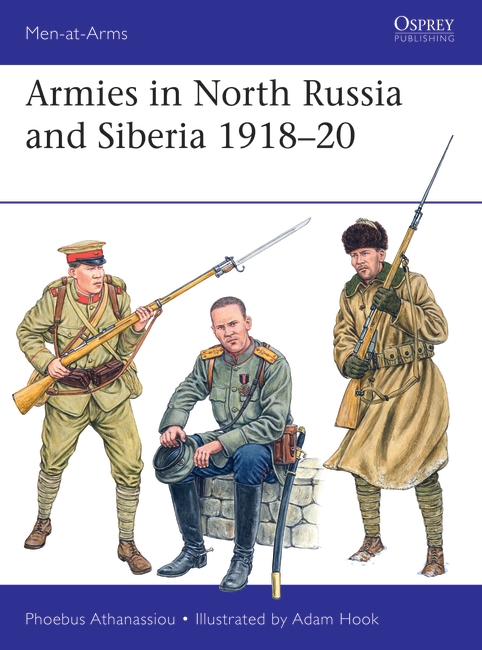
Sometimes history reveals its most compelling stories when you stumble upon details you had never expected to come across. It is such a story that I decided to share with Osprey’s readership. This I now do, with the help of the brilliant artwork of the gifted Adam Hook, which well and truly brings to life the protagonists of a military adventure that deserves to be told and which, in many ways, is more relevant now than ever.
You can read more in MAA 569 Armies in North Russia and Siberia 1918–20.
Comments
You must be logged in to comment on this post. Click here to log in.
Submit your comment