
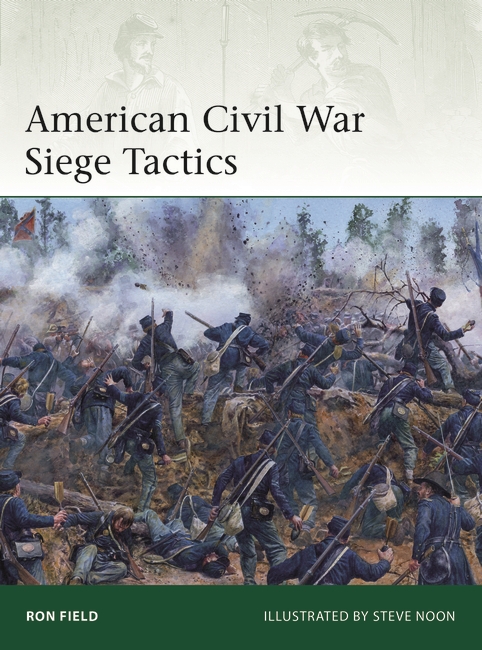
Describing one of the bloodiest chapters in the history of siege warfare during the American Civil War, a Northern newspaper correspondent wrote of the failed assault on the Crater at the Third Louisiana Redan after the fall of Vicksburg, Mississippi, on July 4, 1863, that every kind of weapon was engaged: “every make and brand of cartridge, shell, hand grenade, sky rockets, hot water, live coals, explosive minie balls, buck and ball cartridges, thrown from Enfield, Springfield, Whitworth, Armstrong, Dahlgren, howitzer, mortar, columbiads, Parrots [sic], [and] blunderbusses …” (LDJ, July 11, 1863: 1.5). He concluded that these were just some of the ingredients that contributed to the infernal nature of siege warfare during the bloody conflict from 1861 through 1865.
The tactics of siege warfare in the Civil War had their roots in the American Revolutionary War (1775–83). French military engineers Jean Baptiste Joseph, Chevalier de Laumoy, and Louis Lebègue Duportail, plus Prussian military strategist Baron Friedrich Wilhelm von Steuben, instructed generals of the Continental Army on European siege warfare. On February 8, 1779, Laumoy was deployed to the southern theater of American operations, and advised Major General Benjamin Lincoln, commander of the garrison at Charleston, South Carolina, to surrender during the siege given the inadequate fortifications at his disposal. Serving as Chief Engineer of the Continental Army, Duportail directed the construction of siege works at Yorktown, Virginia, that led to the decisive Franco-American victory on October 19, 1781.
Founded at West Point, New York, in 1802, the United States Military Academy was modeled on the École Polytechnique established in Paris, France, in 1794. While its graduates were well versed in the command of artillery, infantry, or cavalry, they also had a solid grounding in mathematics and military engineering. Professor of Military and Civil Engineering, and of the Science of War, since 1832, Dennis H. Mahan believed in the preeminence of the spade in combat, and drew inspiration from the French military engineer Sébastien Le Prestre, Maréchal de Vauban. Another major influence on Mahan was the 19th-century Swiss military theorist General Baron Antoine-Henri de Jomini. With experience in Napoleon’s Grand Armée and as a military advisor to the Tsar of Russia during the Crimean War (1853–56), Jomini wrote numerous treatises including Summary of the Art of War (1838), which explained the Napoleonic method of warfare, and became the premier military textbook of the 19th century.
After graduation from West Point, a variety of US Army regular officers and men, plus some volunteers, fought in wars during the 1830s and 1840s and had been involved in the construction of siege works in the field. Colonel Joseph G. Totten served as Chief of Engineers during the Mexican–American War (1846–48). As junior officers, Ulysses S. Grant, Robert E. Lee, and Thomas J. Jackson witnessed a classic siege at Veracruz in 1847. As Army engineers, both Lee and George B. McClellan labored side-by-side, overseeing the building of batteries during the remainder of the campaign in central Mexico. Numerous other officers, including McClellan, Totten, John G. Barnard, and Philip St. George Cooke, observed siege-warfare tactics abroad between 1815 and 1861, and some even witnessed fighting. McClellan observed firsthand the Crimean War siege operations at Sebastopol in 1854–55, and this later influenced decisions he made during the Peninsula Campaign in Virginia from March through July 1862.
Despite this earlier expertise, many other officers and most of the enlisted men who served in the Civil War had no experience with siege warfare. To help the former, a variety of manuals and other technical literature was available. Pertinent British texts included John S. Macauley’s A Treatise on Field Fortification (1847) and Hector Straith’s Introductory Essay to the Study of Fortification, for Young Officers of the Army (1858). When the Civil War began in April 1861, available fortification manuals published in the United States included Louis von Buckholtz’s On Infantry Camp Duty, Field Fortification, and Coast Defence (1860) and Dennis H. Mahan’s A Complete Treatise on Field Fortification, with the General Outlines of the Principles Regulating the Arrangement, the Attack and the Defence of Permanent Works. A first edition of Mahan’s work was published in 1836 and reprinted in New York in 1861 and 1863, and in the Confederacy in 1862. This volume became the standard manual on the subject, and contained complete and detailed instructions for planning, constructing, defending, and attacking field fortifications and entrenchments. As the Civil War progressed, new books became available.
You can read more in ELI 271 American Civil War Siege Tactics
Comments
You must be logged in to comment on this post. Click here to log in.
Submit your comment