
The Italian campaign was characterized by slow and limited operational movements; actions were mostly local and dominated by firepower. This was the case at Salerno in 1943, where the German counter-attacks focused on limited areas and were repulsed thanks to the superior Allied firepower, and at Anzio in 1944. The battles for Cassino were in a way even more limited in their operational capabilities, focusing more and more on the town and the abbey on the dominating mountain. The 1944–45 campaign on the Gothic Line repeated the same pattern. Along the frontline, the US 5th Army struggled to advance across the mountainous terrain and the British 8th Army faced a series of defense lines that severely curtailed its operational capabilities. The most successful operation of the whole Italian campaign was the 1943 Termoli landing, which enabled the 8th Army to secure a large area and compel the Germans to withdraw. Still, this success was achieved against an inferior enemy (at the beginning, at least) and produced only limited tactical and territorial gains. Except for the 1945 final offensive, the basic pattern of Allied operational behavior was imposed by terrain and German resistance. The Allies carried out a series of offensives stretching all along the frontline, from the Tyrrhenian to the Adriatic Seas, facing protracted German resistance on a series of defense lines. No real attempt was made to seek a decisive battle, the kind that was achieved through maneuver rather than firepower and could inflict on the German armies a crippling defeat.
The summer 1944 campaign is revealing of the severe limitations on the Allied side. After succeeding in breaking through the German front, the Allied armies started their advance across central Italy and turned the campaign into a war of movement for the very first time. Following its breakthrough from the Anzio beachhead, the 5th Army had the opportunity to strike against the back of the withdrawing German AOK 10 at Valmontone, but General Clark’s decision to turn towards Rome prevented what might have been a decisive success. As the Americans entered Rome on 4 June 1944, the situation from the German point of view was precarious. The eastern wing of the German frontline, the AOK 10, was relatively stronger but also stretched to the south and to the eastern coast, while the western wing (AOK 14) was weaker and deployed in a terrain relatively suitable for armored warfare. Ideally, the Allies should have exploited the situation and the tactical advantages offered to them by their superior mobility and firepower, concentrating their efforts with the aim of cutting off the withdrawal of the German forces. This could have prevented yet another war of attrition, such as the one that was fought on the Gothic Line.
There are several reasons for the failure to achieve this relatively simple aim. The first is the lack of operational capabilities on the Allied side, with the commanders preferring the old-style head-on attack to outmaneuvering tactics. The other one was the strategic situation that followed the seizure of Rome and the Allied landing in Normandy. The Americans basically considered the Italian campaign concluded, and the only strategic aim left was to engage as many German forces as possible to prevent their use on the Western Front. This led to the withdrawal of a large number of Allied units from Italy for the landing in southern France, which greatly reduced the 5th Army’s operational capabilities. Ideally, a major reorganization should have followed with the 8th Army deploying to the west, facing the weaker German defenses, but the relationships between the Allies and American pride prevented that. As a result, the 1944 campaign in central Italy failed to produce any major strategic result, and it did not prevent the Germans from preparing the Gothic Line defenses that eventually halted the Allied advance in the winter of 1944–45.
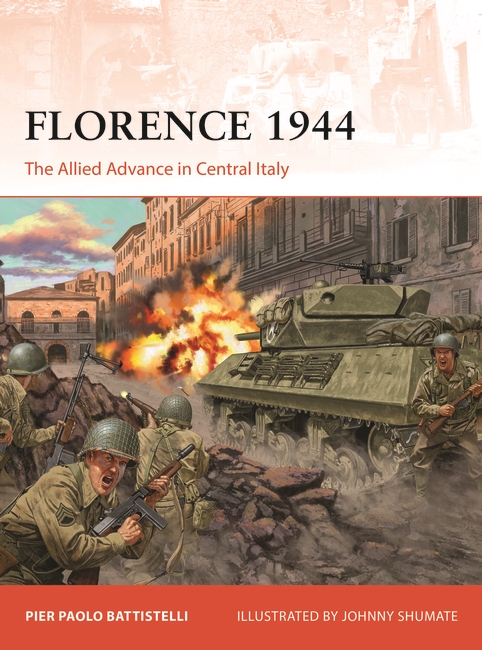
You can read more in CAM 431 Florence 1944: The Allied Advance in Central Italy.
Comments
You must be logged in to comment on this post. Click here to log in.
Submit your comment