
Four Ways the US Invasion of Grenada Created America’s Post-Cold War Military
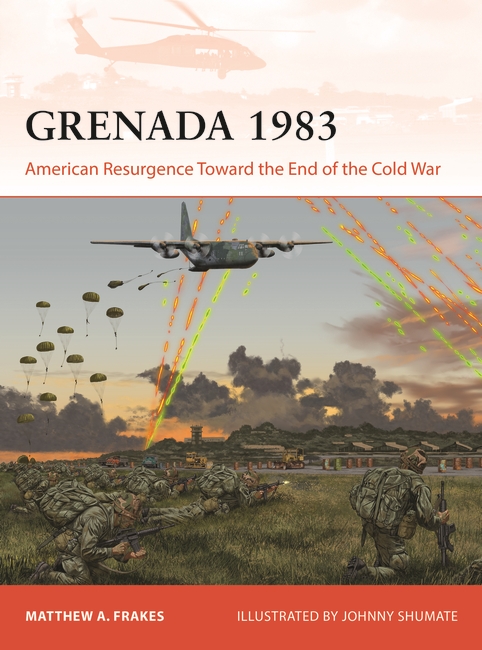
Few Americans today remember the battle for Grenada. Those who have heard of Grenada think of it more as an idyllic vacation spot than as the setting for one of the most significant conflicts of the final decade of the Cold War. But if we want to understand how the United States reshaped its military and reimagined how to use it on the world stage in the years since the Cold War’s end – right up to today’s conflicts in Venezuela and Iran – we need to grapple with the two weeks in the fall of 1983 when the tiny Caribbean island took center stage in the world’s attention. Grenada 1983 tells this story.
The invasion of Grenada by the US and its Caribbean allies unfolded over three days of often-fierce combat, involving moments of heroism and tragedy that successfully restored democracy and turned back communist expansion. The toppling of Grenada’s communist regime unleashed what Governor-General Sir Paul Scoon, a key figure in the campaign and its aftermath, called “the gale force wind of change” that swept across Eastern Europe and eventually the Soviet Union itself as the Cold War came to a close.
However, the most enduring legacy of the Grenada campaign came not from its undeniable importance for the end of the Cold War but rather from the ways it reshaped the US military to confront the new challenges and threats of the post-Cold War world:
1. Regime Change
With the explicit goal of regime change, the invasion of Grenada set a new precedent for how America would use its military power after the Cold War. The Reagan administration initially envisioned the operation on Grenada as a non-combat rescue mission of American nationals attending the medical school there. As it became clear that Grenada’s violent communist regime and the anarchic conditions on the island would not allow US forces to land without a fight, President Reagan made the fateful decision to expand the campaign’s overall objective to regime change. When presented with the request from a coalition of Caribbean states “to depose the outlaw regime on Grenada by any means,” Reagan told his national security team that “if we’ve got to go there, we might as well do all that needs to be done.” The legacy of President Reagan’s decision to use the US military to topple what he considered an “outlaw regime” and help build a democracy in its wake lived on to shape future conflicts from the War on Terror and Iraq to the recent military actions in Venezuela and Iran.
2. Planning for the Unexpected
The military operation in Grenada was not the Cold War campaign for which US leaders had methodically planned and prepared. For decades, planners in the Pentagon had fashioned a military force that could defend Western Europe against attack from the Soviet Red Army. Few had given much thought to deploying US forces for a mission like the one they encountered on Grenada. Rather than a large-scale set-piece battle, the US military had to mount a complex contingency operation with little warning in an unexpected corner of the globe. The mission brought together all branches of the US military, a joint-forces operation that required close coordination between the Army, Navy, Marines, Air Force, and special forces. The unfolding battle exposed many flaws as well as innovations in the US military’s ability to undertake such a mission. These stumbles – in communication, coordination, logistics, and intelligence – led to the pivotal Goldwater–Nichols Act of 1986, which incorporated the lessons of Grenada to reform the Defense Department and the command structure of the US military.
3. Shaping Commanders of the Future
Grenada became a proving ground for the officers who would rise to command America’s post-Cold War military. Most notably, Maj. Gen. Norman Schwarzkopf served as the deputy commander and made critical decisions that shaped the course of the battle on Grenada. Likewise, Maj. Gen. Colin Powell watched the mission unfold from his position on the staff of Secretary of Defense Caspar Weinberger. Both Schwarzkopf and Powell “filed away the lessons learned” from Grenada to lead the US and its allies to victory in the Gulf War of 1991. Many of the officers who led the ground combat in Grenada also rose to the military’s top ranks during the War on Terror after 9/11. Capt. John Abizaid and Capt. David Barno each led a company of Rangers in the thick of the fighting. Abizaid later rose to become the top US commander in the Middle East during the height of the Iraq War, while Barno rose to command coalition forces in Afghanistan.
4. A Proving Ground for Special Forces
The Grenada invasion showcased the skill and tenacity of the US military’s special forces that later played a critical role in the wars of the post-Cold War world. In the wake of the failed mission in 1980 to rescue American hostages in Iran, the Pentagon created the Joint Special Operations Command (JSOC) to oversee the special forces units from each branch of the military. Grenada marked the first combat test for JSOC and its new elite counterterrorist unit, Navy SEAL Team 6, which later became famous for its mission to kill Osama bin Laden. The Army’s clandestine “Night Stalkers” aviation force and its now-iconic UH-60 Black Hawk helicopters also faced their first combat test carrying the SEALs to their targets. The most dramatic moment of the Grenada invasion came when JSOC’s elite Army Rangers, who shouldered the heaviest burden of the fighting, made the largest American combat parachute drop since World War II.
You can read more in CAM 428 Grenada 1983: American Resurgence Toward the End of the Cold War.

Marines from the 22nd Marine Amphibious Unit land near Pearls Airport in the initial wave of the invasion of Grenada on October 25, 1983. (Mike Leahy, Art Collection, National Museum of the Marine Corps)

President Ronald Reagan meets with his national security team in the White House Situation Room on October 23, 1983. (Ronald Reagan Presidential Library)

US Army Rangers make their parachute assault on Point Salines Airport from a height lower than the Washington Monument just after dawn on October 25, 1983. (US Army)
Comments
You must be logged in to comment on this post. Click here to log in.
Submit your comment