
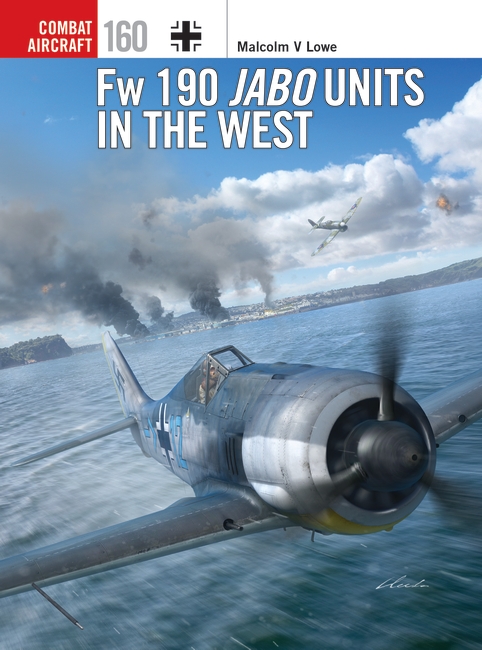
Following the defeat of France in June 1940, the Germans built up a formidable array of fighter and bomber assets on French airfields in preparation for the planned aerial assault against the British Isles. But the Luftwaffe’s lack of overall success in the subsequent Battle of Britain from July 1940 onwards, and the completely separate intended invasion of the Soviet Union in June 1941, had subsequently denuded this large number of operational units and their assets. By mid-1941 only two Jagdgeschwader (JG), JGs 2 and 26, remained on what had come to be called the ‘Channel Front’ facing Britain, both of these units being equipped with the Bf 109. Originally flying the Bf 109E, by mid-1941 the improved and more powerful Bf 109F was coming into widespread service with both units.
One type of warplane that had proven to be of military value during the Battle of Britain was the fighter-bomber, which the Luftwaffe had successfully pioneered as a stand-alone combatant during the summer of 1940. The use of fighter aircraft as makeshift air-to-ground platforms had already worked successfully for Germany’s Legion Condor in the Spanish Civil War, which ended on 1 April 1939. And in a somewhat ad hoc fashion, Bf 109s had been used similarly during the attack on Poland commencing on 1 September 1939, and in the subsequent Blitzkrieg period that culminated in the defeat of France.
In the early days of the Battle of Britain, the rise of the fighter-bomber took on a much more organised and well-executed form with the establishment of Erprobungsgruppe (ErprGr) 210 on 1 July 1940 at Koln-Ostheim. Its 3. Staffel was equipped with Jabo Bf 109E fighters that were specifically configured to carry a bomb beneath the fuselage. The unit’s pilots were specially trained in air-to-ground tactics, and as such, were the first of a new breed of aviators.
Led by Oberleutnant Otto Hintze, 3./ErprGr 210 moved to the French airfield of Denain-Prouvy near Valenciennes on 10 July (the official start of the Battle of Britain according to the British Air Ministry), from where it commenced launching fighter-bomber operations. During the third week of July the unit began taking a toll of maritime targets.
Having thus pioneered Jabo operations, soon 3./ErprGr 210 was joined by other units dedicated to mounting fighter-bomber missions over England. The second organisation thus committed was Lehrgeschwader (LG) 2. In Luftwaffe parlance, Lehrgeschwader has an ambiguous meaning that has been described as an operational training or demonstration unit. However, the two principal Lehrgeschwader that existed during the war, LGs 1 and 2, both took on fully operational frontline roles and saw a considerable amount of combat.
Within LG 2, II.(Schlacht)/LG 2 was the Geschwader’s attack component, and it was also destined to play a key role in the use of the Jabo Bf 109E during 1940. The operational debut for LG 2’s Bf 109E Jabo force came on 2 September 1940. Now declared fully operational within Luftflotte 2, II.(S)/LG 2 undertook its first sorties during a day of raids by the Luftwaffe against various targets in Kent and the Thames Estuary.
As the Battle of Britain progressed, the success of the specific fighterbomber missions flown by 3./ErprGr 210 and II.(S)/LG 2 proved beyond doubt the validity of the concept. In one of his characteristically bombastic pronouncements, the leader of the Luftwaffe, Reichsmarschall Hermann G ing, decr eed that each Jagdgeschwader had to form or convert several Staffeln to fly dedicated fighter-bomber operations. It was on 2 September that this now infamous announcement was made by G ing r egarding the need for each Jagdgeschwader to convert three of its Staffeln into specialist Jabo units. When news of this major alteration to the pursuit of the air war reached the frontline units, there was a very mixed reaction. Subsequently, some Jagdgeschwader were reluctant to carry out this plan, while others were less reticent. Several officers in higher authority were unhappy.
You can continue reading in COM 160 Fw 190 Jabo Units in the West.
Comments
You must be logged in to comment on this post. Click here to log in.
Submit your comment