
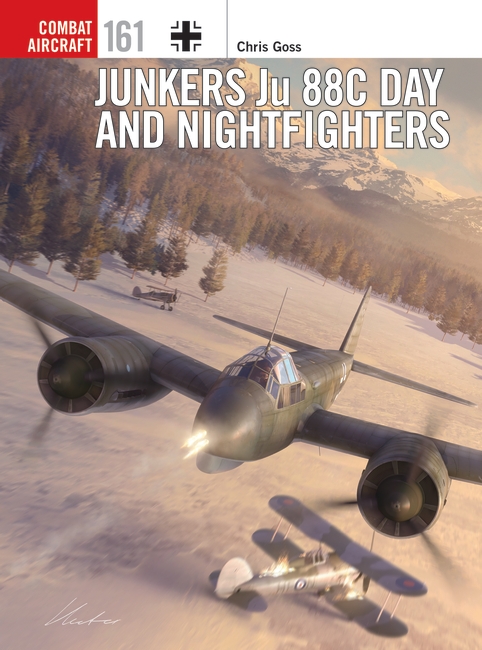
My interest in Ju 88 "heavy fighters" must have come from spending holidays in the La Rochelle/Les Sables D'Olonne area of western France when I was a child in the 1970s. My parents would taken us camping during the hot summer months and only years later did I realise fully what went on around there in the war due to Germany's U-boat fleet operating from there out into the Atlantic and further afield.
Fast forward to 1997, by which time I was 36, when my book "Bloody Biscay" was first published. This essentially was the story of V Gruppe/Kampfgeschwader 40 (V./KG 40) which operated Ju 88C-6s (and later Ju 88 R-2s) out over the Bay of Biscay. I was lucky enough to contact former aircrew of this unit which, as the Battle of the Atlantic intensified, suffered heavy losses but at the same time inflicting losses on the Allies. I found it a fascinating story especially as most crews took photographs.
Following this book, I wrote about the Focke Wulf 200 Condors of KG 40 and then last year, the complete history of KG 40 which operated a number of different aircraft in the maritime role. It really was a fascinating unit which as the war progressed suffered increasing losses of both aircraft and people...
However, in 2023 I co-authored a book with Martin Streetly on the Ju 88 in the fighter role by day and by night. This covered in great detail what the Ju 88C-6 did-intruding, long-range fighter escort over Norway in 1940, day and nightfighter operations over the Mediterranean, train busting, night fighting over north-west Europe and of course V./KG 40. Therefore when Osprey asked me to write about the Ju 88C in the day and night roles, it was a non-brainer for me say yes.
However, the problem for me was always going to be how to tackle the nightfighter aspect and especially concentrating on an ace. The trouble was many German pilots switched types throughout the war. For example, top ace Helmut Lent started on Messerschmitt Bf 110 day fighters, then went to Bf 110 night fighters as well as Dornier 215s before in 1944 converting to the Ju 88 but not the C variant. I therefore decided on Heinrich Prinz zu Sayn Wittgenstein who, after being a bomber pilot on Heinkel He 111s and Ju 88s, became a night fighter pilot starting on the Ju 88C-6 and was killed flying a Ju 88C-6 in 1944, his score of air combat victories by that time standing at 83. I also decided to include night fighter missions flown over the Mediterranean, as opposed to north-west Europe, in 1943. The unit in question Nachtjagdgeschwader 2, flew the Ju 88C-6 the whole time it was in the Med.
You can read more in COM 161 Junkers Ju 88C Day and Nightfighters
Comments
You must be logged in to comment on this post. Click here to log in.
Submit your comment