
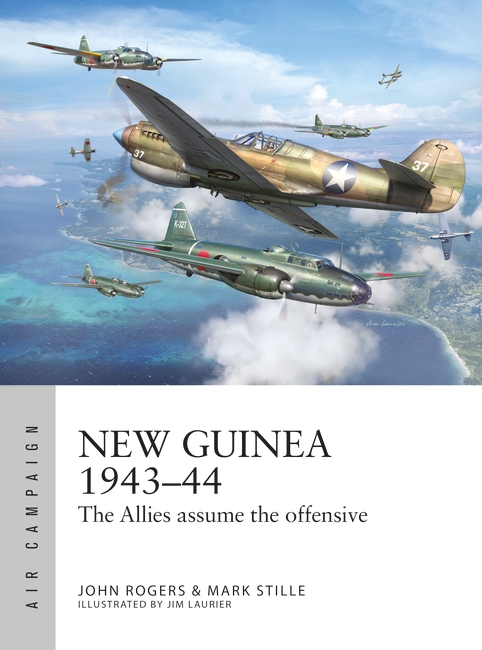
The Allies had, by May 1943, wrested the strategic initiative from the Japanese in New Guinea. General Douglas MacArthur, Supreme Commander of the Allied Forces, Southwest Pacific Area (SWPA), was granted strategic authority over Admiral William Halsey’s South Pacific (SOPAC) theater forces to coordinate plans and operations between the neighboring Allied forces for seizing control of the straits between New Guinea and New Britain during 1943. These objectives were in line with MacArthur’s long-term desire to press forward with the capture of New Guinea preparatory to retaking the Philippines. Air power would be vital to accomplish MacArthur’s ambition. MacArthur called upon Lieutenant General George Kenney, the Allied Air Forces commander, to devise the plans and methods to facilitate the Allied conquest of the whole of New Guinea.
For the Japanese, the slow but steady growth in Allied airpower forced their Imperial General Headquarters (IGHQ) to revise its earlier expansive strategy to one of establishing a defensive perimeter that could realistically be held given the resources available for the South Pacific. Since the Imperial Japanese Navy (IJN) and Imperial Japanese Army (IJA) did not enjoy a cooperative relationship, rather functioning as antagonistic entities with different strategic objectives and operational outlooks, the formulation and execution of this revised strategy was muddled and incomplete. Their commitment and use of air power to defend Japanese positions in New Guinea suffered greatly from this strategic confusion. This situation ultimately resulted, in the case of New Guinea, in their utter inability to halt, or even significantly impede, the series of Allied offensive moves that saw the destruction or entrapment of significant IJA forces in New Guinea by July 1944.
Though the Allies faced significant problems in accumulating, maintaining, and managing their air assets throughout the campaign, the chief reason for their ultimate victory lay in their ability to respond to challenging circumstances both reasonably and flexibly. In this they were, of course, greatly aided by good intelligence from communications and photographic reconnaissance, but they also had the advantage of both the strategic and operational initiatives that allowed them to clearly visualize their objectives and thoroughly prepare for supporting air operations. They also successfully orchestrated their assets across the entire theater. For their part, Japanese forces were attempting to hold a front of approximately 1,200 miles from Lae and Salamaua in eastern New Guinea to the Central Solomons. Their forces were totally inadequate to cover such an extended front and thus were overextended. Making their situation almost impossible was that the movement of reinforcements and supply to critical points in this huge battle area had to be conducted in the face of growing Allied air and sea power. Despite the almost continuous infusion of units and replacement aircraft, from the second half of 1943 the Japanese faced a growing numerical disadvantage in the air. Without achieving at least local air superiority, the Japanese were consistently unable to respond to the series of swift and powerful Allied blows and therefore suffered serious attrition. In such a battle of attrition, which the New Guinea air campaign was, the Japanese had little hope of victory.
You can read more in ACM 63 New Guinea 1943–44: The Allies assume the offensive
Comments
You must be logged in to comment on this post. Click here to log in.
Submit your comment