
Having published an Osprey New Vanguard examining the Red Army’s tank force at Kursk in 1943, my attention was drawn to how its armored capabilities evolved in 1942, the year of Stalingrad. In January 1942, the Soviets could only field small, understrength tank brigades during the battle of Moscow after losing over 20,000 tanks during the first disastrous months of the war, but by the summer of 1942, the Red Army would meet the panzer divisions with a reborn armored force.
Much attention focuses on the superb T-34, the Red Army’s key tank, but the Soviet inventory was much more varied. The less mobile KV-1 was still present in large numbers, but less favored by the Soviets as the Germans fielded improved guns and ammunition that could penetrate its heavy armor. A third of Red Army armored brigades consisted of inferior, two-man light T-60s and T-70s, produced in large numbers due to the continuing heavy losses to the tank force. In 1942, Lend-Lease tanks played their most significant role on the Eastern Front, although the Matilda and M3 Grant were poorly regarded by the Soviets. The Red Army was also lukewarm about the M3 Stuart light tank, although it was clearly superior to the T-60 and T-70. Notably, the Valentine tank, regarded obsolete in the West, was so liked by the Red Army that it would serve in the light- tank role for the rest of the war.
Realizing the need for a stronger armored punch, the Red Army formed its brigades into new tank corps and tank armies in 1942. Despite these improvements, hasty training programs, poor tactics, and inexperienced leaders and staffs led to a series of costly defeats. Of the eleven major offensives launched by the Soviets during the year that used multiple tank corps, the first nine were costly defeats. Much of the fault lay with Stalin, who during the summer and autumn repeatedly ordered immediate attacks by hastily assembled armored formations that left no time for preparation, planning, or even basic reconnaissance.
In the winter of 1942, the Red Army’s tank force was at last able to achieve its first major victory by smashing the forces of Hitler’s Romanian and Italian allies. Operation Uranus deftly targeted the thinly stretched and less well-armed Romanian forces rather than attack German units head-on, resulting in the encirclement and ultimate destruction of the Sixth Army in the ruins of Stalingrad. Little Saturn was similarly launched against another weaker Axis allied force, the Italian Eighth Army. In both operations, once enemy lines were penetrated, the Red Army’s tank, mechanized, and cavalry corps were able to conduct deep exploitation operations for the first time.
Spurred by the lessons of 1942, the Red Army strove to improve its armored force. The ad hoc tank armies of 1942 were replaced with a new, specialized tank army organization, consisting solely of tank or mechanized corps to allow rapid maneuver and exploitation operations. Proven, battle-tested armor leaders were assigned to lead the tank corps and armies. After halting Hitler’s last bid to secure the strategic initiative in the east at Kursk, the Red Army’s tank corps and armies, rebuilt, rearmed, and reorganized based on the hard lessons of 1942, led the way to ultimate victory.
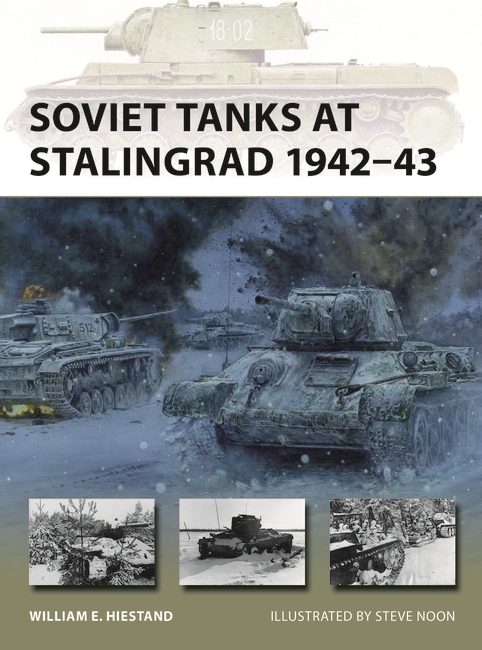
You can read more in Soviet Tanks at Stalingrad 1942–43 by William E. Hiestand.
Comments
You must be logged in to comment on this post. Click here to log in.
Submit your comment