
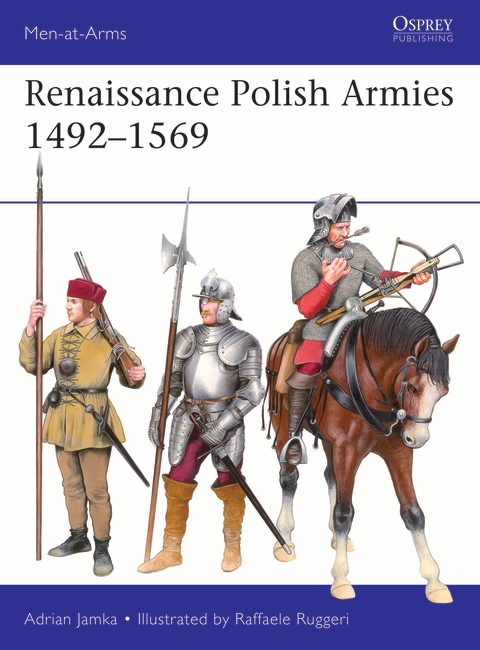
The Polish military of the Renaissance has not received much attention in English-language works, but it was nevertheless a crucial period during which it evolved from the late medieval model into the famous Polish military of the latter part of the 16th century and the 17th century. Renaissance Polish Armies 1492–1569 aims to introduce English-speaking readers to this fascinating period in Polish military history.
The book begins in 1492, a symbolic date marking the end of the Middle Ages. It was also the year that King Casimir Jagiellon of Poland and Grand Duke of Lithuania died, leading to the dissolution of the personal union and the reign of his successors. John I Albert was elected as King of Poland, while Alexander took over the Grand Duchy of Lithuania. The end date, 1569, saw the Union of Lublin, which established a true union between the Kingdom of Poland and the Grand Duchy of Lithuania. The year 1492 was also the date when the first Polish standing force, obrona potoczna, was established.
While writing a book about Polish armies of the Renaissance, it was impossible to ignore the hussars. The history of Polish hussars in literature is dominated by works focusing on the period of the Polish-Lithuanian Commonwealth (primarily the last three decades of the 16th century and the 17th century), with much less focus on the earlier period (especially in English-language literature). These cavalrymen appeared in Poland at the turn of the 15th and 16th centuries and quickly became a vital element of the Polish military.
Reconstructing the figures of these cavalrymen presents an interesting challenge. This raises the question: how exactly did these cavalrymen look like? What types of sources are most reliable? The first types of sources that come to mind are material sources (such as weapon exhibits) and iconographic sources. For the first half of the 16th century, we have a number of iconographic sources important for understanding the appearance and armament of hussars.
A particularly important source is the monumental painting The Battle of Orsha, which was most probably painted in the 1530s. The hussars depicted in the painting are lightly armed cavalrymen. They wear Balkan attire and their equipment consists of a lance, sabre and shield. Similar images of the hussars are consistently depicted in other iconographic sources (for example in Michael Lancz's painting Conversion of St. Paul).
In addition to iconographic sources, however, there are a number of written sources, such as normative acts, narrative accounts (such as chronicles), and muster rolls. Particularly important in this case are muster rolls, administrative documents prepared by a field clerk during a review of a military unit. These documents describe the soldiers' horses and weaponry. So what image of the hussar does emerges from these registers? Muster rolls depict hussars carrying lances and shields, but also clad in mail, and usually wearing helmets. Furthermore, from around 1530, many hussars began to wear mail shirts with plate elements, as well as cuirasses consisting of a breastplate and backplate. Therefore, the image of a light cavalryman known from iconographic sources must be supplemented with an armour and helmet, resulting in a fairly well-armored rider.
This example demonstrates that great caution should be taken when reconstructing warriors from the past. Only a combination of several sources can lead to satisfactory results, while relying on a single type of sources (even if it is consistent) can lead one astray.
You can read more in MAA 568 Renaissance Polish Armies 1492–1569.
Comments
You must be logged in to comment on this post. Click here to log in.
Submit your comment