
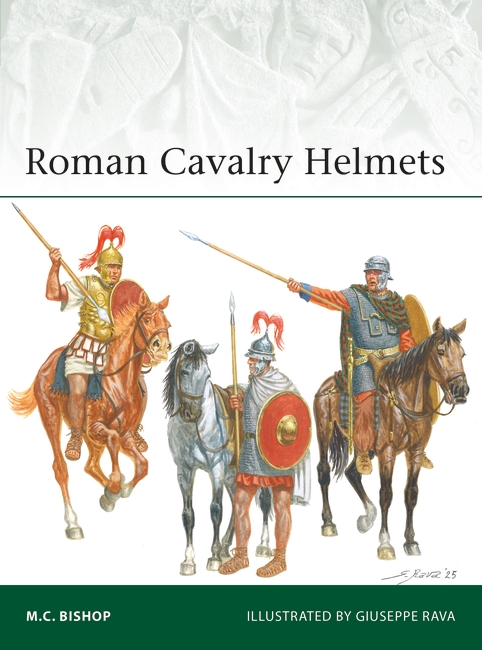
In contrast to Roman infantry helmets (see my earlier blog), the helmets of Roman cavalrymen underwent a rather different series of developments. They certainly had a common origin, partly because Roman citizen cavalry of the Republican period tended to be employed more like mounted infantry, coming to a halt or even dismounting before contact with an enemy (much to the surprise of Macedonian cavalry, it has to be said). The increasing use of ethnic cavalry by the Romans, particularly European ‘Celtic’ peoples, introduced new types of equipment beyond the original Montefortino-type helmet (which itself they acquired from the Celtic peoples of northern Italy via the Etruscans). Xenophon himself had recommended the Boeotian helmet for Greek cavalry and the relief from the so-called Altar of Domitius Ahenobarbus shows a cavalryman wearing something similar, probably a derivative form known as a Western Celtic helmet.
An important change came with the arrival of Augustus as the first princeps, with cavalrymen beginning to modify infantry helmets. A basic steel core – a helmet bowl with small neck guard and hinged cheek pieces – was adorned with a decorative skin of (costly) copper alloy, enriched with embossed decoration, in turn enhanced with tinning or silvering. The bowl often imitated human hair, and some examples went so far as to use woven ‘wigs’ to achieve this effect. Such helmets, typified by a piece from Xanten (Germany), were often shown on the elaborate equestrian tombstones of the Early Principate and finds from across the empire confirm their method of construction. They had fairly small neck guards, partly because they did not need the ever-larger protection of infantry helmets, due to the way in which cavalry tended to be used for mopping-up operations. From now onwards, cavalry helmet cheek pieces invariably covered the wearer’s ears, perhaps indicating that vocal commands were less significant for riders than musical or standard-based direction when they had to contend with the thunder of a horse at full tilt.
At the same time, the adoption of the form of cavalry display and training known to Arrian as hippika gymnasia (probably a translation into Greek of the Latin exercitatio equestris) led to the addition of face-mask helmets to the equipment of some (not all) cavalrymen. In his description, Arrian stressed that these were different to battle helmets. These were all forged from ferrous metal or brass with no skinning of a core and mimicked the face of an expressionless androgynous youth on the mask (or persona) which was hinged to the bowl at the brow. While offering additional protection to the wearer over an ordinary helmet, they also limited his field of vision and thus presented an extra challenge to the rider during these exercises. The Ribchester helmet is probably the best-known example of the fully formed early face-mask helmet.
Battle helmets began to evolve in the 2nd century AD, adopting what has become known as the pseudo-Attic form. An example from Theilenhofen (Germany) even incorporated a stylized moulded feather crest atop the bowl. Although still a copper-alloy sheathing over a ferrous core, they now imitated the classical Attic style of helmet in the actual bowl, although cheek pieces changed little in their form and decoration. Tinning was still used to emphasize the details of the underlying brass, so it might be said that battle helmets had changed while remaining essentially the same.
The Later Principate saw further developments, with another conservative throw-back form, the pseudo-Corinthian helmet, becoming popular for cavalry. These changes in design probably owe more to fashion than to changing needs, since the cavalry helmets of the Early, High and Late Principates are essentially the same: one-piece bowl, decorative skinning and independent hinged cheek-pieces. The pseudo-Corinthian form aped the larger cheek pieces of contemporary infantry helmets, however, and ultimately fused them into a single visor, leaving a T-shaped opening for eyes and mouth, as with a helmet from Heddernheim (Germany).
Face-mask helmets had also evolved, now being themed to reflect the Trojan Wars, with examples of Greek, Amazon and Trojan types now being recognized. The Crosby Garrett helmet is now a well-known example of the last form and this thematic approach suggests that the hippika gymnasia had evolved its teams format to provide an imitation of long-ago combats on the plain of Troy. Even Roman cavalrymen seem to have daydreamed.
It was then a short step for the two types of helmet – battle and face-mask – to reunite. Replacing cheek pieces with a visor on the pseudo-Corinthian type of battle helmet made it a simple matter to add a removable face mask into the T-shaped opening and, thus, two types became one with the hybrid Pfrondorf (Germany) helmet.
The period of the transition from the Late Principate to the Dominate saw a radically different form of cavalry helmet arrive. The bipartite 3rd-century AD Persian helmet from the mine at Dura-Europos (Syria) presaged a major change in the construction of cavalry helmets. This coincided with a more centralized system of production in state arms factories. The complex single-piece bowl of Principate-era helmets was replaced with one built up from components, recalling the two halves of the Dura helmet. Separate cheek pieces also returned, large enough to encompass the whole of the side of the face, while neck guards were also now separate and hinged to the bowl in the same way as the cheek pieces. Once more, however, a ferrous core was adorned with skinning, but now silver gilt was the most common form, rather than tinned or silvered copper alloy. In the case of many helmets, like that from Peel/Deurne, the sheathing survived while the core did not; others still saw the ferrous core discarded after the valuable sheathing had been stripped off.
Dominate cavalry helmets featured separate brows and nasals attached to the front of the bowl. Comparison with later Anglo-Saxon and Viking helmets shows that the influence of this form of helmet, like the spatha, lived on into the early medieval period.
There was no longer a need for face-mask helmets, since the hippika gymnasia died with the Principate. Indeed, if Ammianus Marcellinus is to be believed, the Romans seemed somewhat bemused when they encountered Sassanid Persian armoured cavalry wearing face masks, having evidently forgotten their own history with the type.
Ultimately, Roman cavalry helmets fulfilled slightly different functions to those of infantry. Aside from displaying the comparative wealth of auxiliary cavalrymen, they offered protection where it was needed and not where it served little purpose. Of course, like modern riding helmets, they also helped protect the rider in the event of a tumble or a tantrum on the part of a mount!
You can read more in ELI 268 Roman Cavalry Helmets.

The Early Principate Xanten helmet (image MCB/Flickr/CC BY-SA 4.0)

The Ribchester face-mask helmet (image Rex Harris/Wikimedia/CC BY 2.0)

The Pfrondorf helmet (image Lindenschmit/Public Domain)

The Peel/Deurne Dominate helmet (image Rudolphous/Wikimedia/CC BY-SA 4.0)
Comments
You must be logged in to comment on this post. Click here to log in.
Submit your comment