
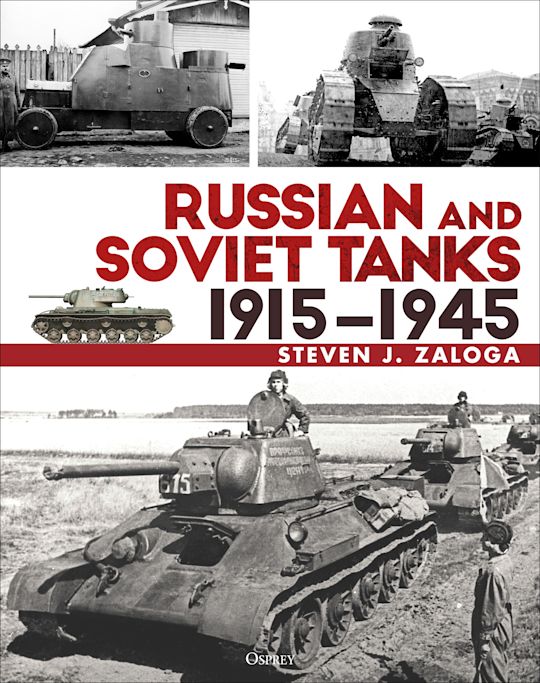
This book is the first of a two-part set covering Soviet tanks from 1915 to the present. This first volume begins with the early attempts in Tsarist Russia to develop armored vehicles, the use of armored vehicles by the Russian army in World War I, and the subsequent arrival of the first tanks during the Russian Civil War.
The Soviet Union attempted to develop tanks in the 1902s, with very limited results. Aside from the country’s economic exhaustion after war and revolution, Russia did not have a strong automotive industry. In the late 1920s, Stalin decided to invest Soviet gold reserves in a major industrialization program that included the creation of a viable tank industry. As a result, the Soviet Union produced more tanks in the 1930s than the rest of the world combined. Most of these tanks were based on imported designs. The T-26 infantry tank was based on the British Vickers 6-ton tank. The BT cavalry tank was based on the American Christie tank.
The Spanish Civil War in 1936–39 put the new Soviet tanks to the test. They were surprisingly effective against the weakly-armed and thinly armored German Pzkpfw I and Italian L3 tankette. Rather than rest on their laurels, Soviet tank designers argued that the real lesson of Spain was that tanks needed better armor and better guns. This resulted in the legendary T-34 and KV tanks that entered Red Army service before the start of the 1941 war with Germany.
Operation Barbarossa in June 1941 crushed the Red Army and resulted in the great tank massacre when 13,000 Soviet tanks were lost in only a few weeks. In spite of the technical innovation of the T-34 and KV tanks, the Red Army was catastrophically unprepared. The next year was spent resurrecting the Soviet tank industry in the Urals and rebuilding the tank force. Compromises were necessary. The wretched T-60 and T-70 light tanks were manufactured in large numbers as a stopgap. The quality of the T-34 tank sank due to the chaos in the industry. But by the end of 1942, the Soviet tank force was beginning to recover, evidenced by the Stalingrad victory. The battle of Kursk in the summer of 1943 showed that the Soviet tank force had lost its technological edge. Soviet tank design had stagnated since quantity was given greater emphasis than quality. In the autumn and winter of 1943, new designs emerged, notably the T-34-85 and IS-2 heavy tank.
By 1944, the Red Army was approaching technical parity with the German Panzer force. The new tanks helped, but the growing experience of Soviet tank commanders was equally crucial. Battlefield prowess such as Operation Bagration in the summer of 1944 marked the steady decline of the Wehrmacht on the Russian front. By 1945, Germany was sandwiched between the advances of the UK and USA in the West, and the Red Army in the East.
This book examines the tumultuous history of Soviet tanks over this thirty-year period. It is amply illustrated with both color illustrations and photographs.
Comments
You must be logged in to comment on this post. Click here to log in.
Submit your comment