
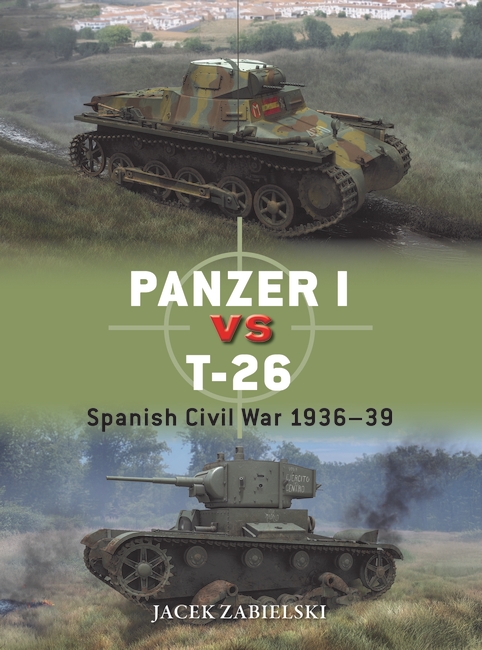
When we think of tank warfare in World War II, images of Tigers and Panthers clashing with T-34s often come to mind. Yet the foundations of modern armoured combat were laid much earlier, in the 1930s, by far humbler machines. Among the most important of these were two light tanks that would shape the doctrines, experiences and expectations of their respective armies: Germany’s Panzerkampfwagen (PzKpfw) I and the Soviet T-26.
The duel between these two vehicles was not merely a technical comparison. It was a clash of doctrine, industrial philosophy and political ambition, fought first in the crucible of the Spanish Civil War and later echoed across the early battlefields of World War II.
Two Tanks, Two Visions
At first glance, the PzKpfw I and the T-26 appear superficially similar: both were small, lightly armoured infantry-support tanks developed in the early 1930s. In reality, they reflected radically different approaches.
The PzKpfw I was conceived under the constraints of the Versailles Treaty, designed primarily as a training vehicle, a stepping stone toward the creation of a mechanized force Germany had been forbidden to possess. Armed only with twin machine guns, lightly protected and cramped even by contemporary standards, it nevertheless played a vital role in building the Panzerwaffe’s organizational culture. More than a weapon, it was a schoolhouse on tracks.
The T-26, by contrast, was conceived as a true infantry-support tank. Based on the British Vickers 6-Ton, it was quickly adapted to Soviet needs and mass-produced on an unprecedented scale. Its early machine-gun variants were soon replaced by versions armed with a 45mm gun, giving it a decisive firepower advantage over most contemporary light tanks – including the PzKpfw I. By the mid-1930s, the Red Army possessed not only the largest tank force in the world, but one equipped with vehicles capable of defeating any likely opponent.

The T-26 and PzKpfw I fought side by side by the end of the war, as captured Soviet-built vehicles were pressed into Nationalist service against Republican forces. (Author’s Collection)
Spain: The First Duel
The Spanish Civil War (1936–39) brought these two tanks face to face for the first time. For Germany and the Soviet Union alike, Spain became a testing ground – politically deniable, tactically revealing and strategically formative.
German PzKpfw I units, operating with Nationalist forces, initially enjoyed success against poorly organized opposition. That illusion was shattered with the arrival of Soviet-supplied T-26s supporting the Republican Army. For the first time, German tank crews encountered an enemy vehicle that could destroy them from beyond effective machine-gun range.
The impact was immediate and sobering. PzKpfw I crews were forced to rely on improvisation: cooperation with anti-tank guns, aggressive manoeuvre and close coordination with infantry. German instructors quickly recognized that tanks could not operate in isolation and that armour-versus-armour combat required combined-arms solutions, not just better vehicles.
For the Soviet Union, Spain offered different lessons. The T-26 proved tactically effective, but heavy losses revealed weaknesses in crew training, maintenance and command-and-control. The Red Army learned – sometimes painfully – that numerical and technical superiority alone did not guarantee success. These early encounters left a deep imprint on both sides.
Germany emerged from Spain convinced that tanks must be employed as part of a mobile, combined-arms system, integrated with artillery, engineers, infantry and air power. The PzKpfw I, obsolete as a fighting vehicle, had fulfilled its purpose as a training platform and doctrinal incubator.
The Soviet experience was more ambiguous. While the T-26 had demonstrated its battlefield potential, the Red Army struggled to convert that potential into consistent operational success. Political purges, doctrinal upheaval and organizational instability undermined many of the lessons learned in Spain.

German- and Soviet-built tanks shelter beneath Spanish olive trees during the Civil War – former rivals of Europe’s future battlefields meeting for the first time on Iberian soil. (Author’s Collection)
From Spain to the Eastern Front
By June 1941, both tanks were already obsolescent. The PzKpfw I had largely been relegated to secondary roles, while the T-26 – still present in large numbers – was vulnerable to modern anti-tank weapons and air attack. Nevertheless, thousands of these vehicles fought in the opening months of the German–Soviet war.
Here, the contrast between quantity and quality, doctrine and execution, became stark. Soviet formations fielded enormous numbers of T-26s, but often without adequate support, training or coordination. German forces, though frequently outnumbered, applied lessons learned since Spain with devastating effect.
The story of the PzKpfw I and the T-26 is not about which tank was ‘better’. It is about how armies learn, how doctrine evolves, and how early missteps shape later success – or failure.
Osprey Publishing’s Duel 152: Panzer I vs T-26 explores this formative period in depth, combining technical analysis with combat history, personal accounts and detailed visual material. From design bureaux and training schools to the streets of Madrid and the steppes of the Soviet Union, the book traces how two modest vehicles helped define the future of armoured warfare.
In many ways, the PzKpfw I and the T-26 were already relics by the time the great tank battles of World War II were fought. Yet without them, those later battles – and the doctrines that governed them – would have looked very different.
Sometimes, history turns not on giants, but on the small machines that taught armies how to fight.
Comments
You must be logged in to comment on this post. Click here to log in.
Submit your comment