
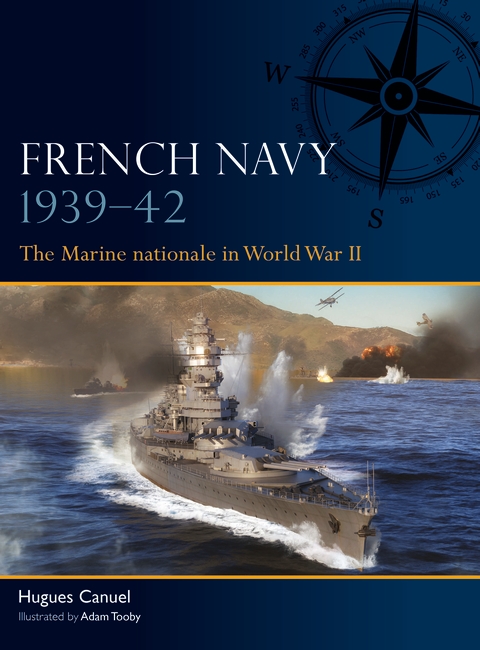
When France collapsed in June 1940, the image that fixed itself in popular memory was one of stunned soldiers on dusty roads, of refugees moving south, of a nation overwhelmed in six weeks. At sea, the story was different. In 1939, the Marine nationale was the fourth-largest navy in the world. It possessed fast battleships designed to counter German raiders, some of the most powerful cruisers and destroyers afloat, one of the largest submarine fleets in existence, and a global network of bases stretching from Brest to Dakar, from Toulon to Saigon. It had modernized aggressively throughout the interwar years and had carefully studied the lessons of the First World War. Its admirals believed they were ready.
And yet, within three years, much of that fleet lay at the bottom of its own harbor in Toulon — scuttled by its crews in one of the most dramatic acts of naval self-destruction in history. How does a navy go from confident modernization to self-inflicted ruin without ever suffering a decisive fleet defeat? That question sits at the heart of the French naval story between 1939 and 1942.
A Fleet Built in the Shadow of the Great War
French admirals entered the Second World War shaped profoundly by their experience as young officers in the First. They had fought a largely uncelebrated war at sea – containing the Austro-Hungarian fleet in the Adriatic, protecting trade routes across the Mediterranean, adapting to submarine warfare in the Atlantic – but without earning the kind of dramatic victories that confer institutional prestige. The interwar years became an opportunity for redemption.
The Marine nationale rebuilt itself deliberately. It streamlined command structures, invested in professional education, and embraced technological innovation within the constraints of the Washington Naval Treaty system. France’s shipyards launched nearly 700,000 tons of warships between the early 1920s and 1939. Fast battleships like Dunkerque and Strasbourg were conceived as precise answers to German “pocket battleships.” The Richelieu class promised parity with the most powerful capital ships afloat. Cruiser construction flourished. Destroyers achieved extraordinary speeds. Submarines proliferated.
It was not a fleet designed for imperial pageantry. It was built for war in the Mediterranean and the Atlantic against real continental rivals. And in September 1939, it went to war.
No Phoney War at Sea
While the Western Front remained static through the winter of 1939–40, there was nothing “phoney” about the naval war. French ships escorted convoys across the Atlantic, hunted German commerce raiders, patrolled neutral waters, and joined Anglo-French task forces searching for the Admiral Graf Spee and other German capital ships. Submarines deployed into the North Sea. Destroyers strained under relentless escort duty in winter seas for which they had not been designed.
When Germany invaded Norway in April 1940, French cruisers and destroyers fought in Arctic waters under constant air attack. At Dunkirk, French warships helped evacuate tens of thousands of Allied troops, suffering heavy losses in the process. At sea, the Marine nationale performed credibly in coalition with the Royal Navy. The fleet was never beaten. France was.
Collapse on Land, Resolve at Sea
The German breakthrough in May 1940 confronted French naval leaders with a crisis few had imagined possible: how to preserve the fleet in the face of national collapse. Even as the army disintegrated, French warships continued to fight. They bombarded Italian positions after Mussolini’s declaration of war. They evacuated Allied troops from Channel ports. They shepherded incomplete battleships like Richelieu and Jean Bart to North African safety rather than allow them to fall into German hands. When the armistice came into force, the fleet was largely intact. That survival, paradoxically, created the next crisis.
Allies No Longer
To British leaders, a powerful French fleet under the control of an ambiguous Vichy regime represented an existential threat. If Germany gained access to those ships, Britain’s survival might be imperiled. On 3 July 1940, the Royal Navy opened fire on French ships at Mers el-Kébir after failed negotiations. Nearly 1,300 French sailors were killed. Other French vessels were seized or immobilized across the globe. The rupture was profound.
From that moment, the French fleet existed in a suspended state – no longer fighting the Axis, unwilling to join Britain, and determined above all to preserve its autonomy. It would fight again – against the Allies off Senegal and the Levant, in Madagascar, out of North Africa during Operation Torch – not out of ideological alignment with the Axis, but out of a rigid interpretation of sovereignty and legality. The Marine nationale had become a fleet defending a state that no longer truly defended itself.
Yet not all French sailors accepted that suspended existence. A small but determined minority rallied to General Charles de Gaulle’s appeal from London, forming the Forces Navales Françaises Libres (FNFL). Drawn from ships detained in British ports, from crews who chose exile over obedience, and from colonies that rejected Vichy authority, the Free French Naval Forces remained modest in size but significant in symbol. Submarines such as Narval and the powerful cruiser-submarine Surcouf, corvettes provided by Britain, and a handful of colonial vessels flew the Cross of Lorraine off their jack staff while serving with Allied fleets. Their tonnage was limited; their political impact was not. At sea, they ensured that France never entirely disappeared from the Allied order of battle, even as the bulk of the fleet remained bound to Vichy.
Technology, Doctrine, and Limits
The French fleet of 1939 was modern in many respects, but it carried structural weaknesses that wartime operations quickly exposed. Naval aviation lagged behind British and American standards. The aircraft carrier Béarn was obsolete. Radar was absent. Anti-aircraft defenses were inadequate for the era of dive-bombers and torpedo aircraft. Anti-submarine warfare coordination lagged behind the rapidly evolving U-boat threat. Submarines, though numerous and ambitious in design, struggled with mechanical reliability and doctrinal cohesion.
None of these flaws doomed the fleet on their own. But together they reveal something important: modernization is not the same as transformation. France had built excellent ships. It had not fully adapted to the emerging realities of industrial, air-dominated, electronically enabled naval warfare.
Toulon: The Final Act
In November 1942, after Allied landings in North Africa and the German occupation of Vichy’s “Free Zone,” the crisis reached its climax. German forces moved to seize the fleet at Toulon. French admirals had long prepared for this contingency. Orders were clear: the fleet must not fall intact into foreign hands.
On 27 November 1942, crews opened sea-cocks, detonated charges, and set fires. Battleships, cruisers, destroyers, submarines – more than seventy vessels – were scuttled. The fleet that went down was not a fleet defeated in battle, it was a fleet denied to everyone. The act preserved a measure of honor in the eyes of its officers and sailors. It also symbolized the tragic arc of a navy that had modernized, mobilized, fought, survived, and finally destroyed itself because the political framework sustaining it had collapsed.
Why This Story Matters
The history of the French Navy in the early Second World War is not simply a catalogue of ships or engagements. It is a study in the relationship between institutions and states. It shows how a military organization can be professionally competent yet strategically constrained. How technological modernization can coexist with doctrinal blind spots. How loyalty to legality can become entangled with loyalty to a compromised regime. And how, within the same institution, different officers and crews could reach radically different conclusions about where honor and legitimacy truly lay.
The Marine nationale fractured in 1940, but it did not disappear. While the bulk of the fleet remained under Vichy authority – disciplined, constrained, and ultimately self-destructive at Toulon – a minority chose another path, rallying to Free France and keeping a French naval presence alive within the Allied coalition. Between those two trajectories lay the full tragedy of the French naval experience: a fleet that survived tactically yet lost politically, an institution caught between obedience, sovereignty, and survival.
Above all, this story challenges the simplified narrative of 1940 as a one-dimensional military collapse. At sea, the outcome was more complicated – and as tragic. The Marine nationale was not swept aside in a decisive Trafalgar or annihilated in a Jutland. It endured. It fought. It fractured. It chose destruction over capture. And from that fracture, through eventual reunification in 1943 (which I discussed further in my previous book The Fall and Rise of French Sea Power), would emerge the foundations of a reborn French Navy. For a service that had long sought recognition after the First World War, its Second World War experience remains one of the most complex and revealing in modern naval history. It deserves to be remembered not as an afterthought, but as one of the central maritime dramas of the war’s opening years.
You can read more in Fleet 16 French Navy 1939–42: The Marine nationale in World War II
Comments
You must be logged in to comment on this post. Click here to log in.
Submit your comment