
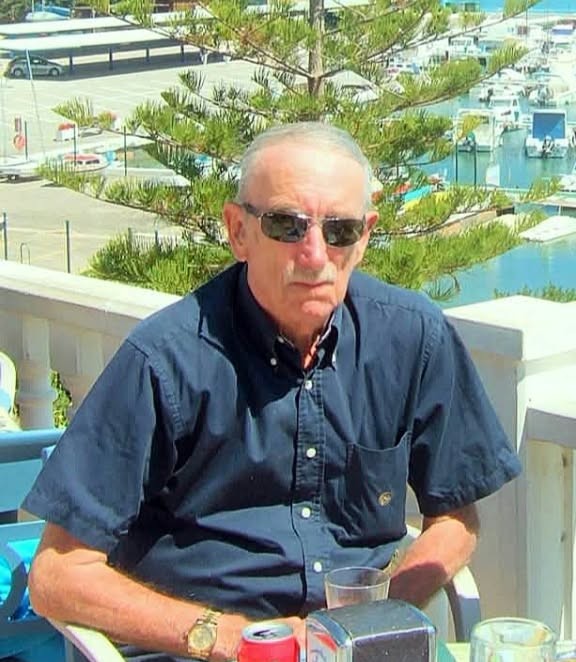
One of Osprey’s best-loved and most prolific illustrators, Tony Bryan, died on 22 September 2026 at the age of 84. Angus Konstam, who worked with him for nearly 20 years, pays tribute.
One of the great things about Osprey’s books is that they team an author up with an artist. While one of them produces the text and supplies the images, they also provide art references, so that the artist can produce the most historically accurate plates possible. So, there’s a lot of to-ing and fro-ing between author and artist, to get those artwork plates right. They’re important, as not only are they the first thing a reader sees, on the book’s cover, but in the spirit of a picture telling a thousand words, they also add immensely to the book.
My first book for Osprey was published in 1993, which is probably further back than I can recall these days. Just over quarter of a century ago, though, in 2000, Osprey teamed me up with a new freelance artist, who’d a lot of experience in painting military subjects, particularly tanks, ships and aircraft. That was Tony Bryan. His background was in engineering, before he worked in military research and development. He then drew on his long experience of technical-style drawing to turned his very proficient hands to military illustration. Tony and I immediately hit it off. I’ve worked with a lot of great artists over the years, including my first, Dave Rickman, as well as Angus McBride, Peter Dennis and Gerry Embleton. Tony, though, was special.
When that first book came out in 2001, the New Vanguard title British Napoleonic Ship-of-the-Line, I was hugely impressed by his artistry, especially the attention to detail he’d honed in his engineering days. So, as they said in Casablanca, this was the start of a beautiful friendship. Of course, it wasn’t just me who worked with Tony. Over a dozen Osprey authors benefited from Tony’s skills as an artist, and before he finally put down his paintbrush, Tony had produced artwork for no fewer than 66 Osprey titles, as well as collaborating on four more. Of those other authors, David Fletcher from the Tank Museum in Bovington – just down the road from Tony – as well as the superb US authors Mark Stille and Steve Zaloga were the main beneficiaries, particularly Steve, who had a dozen books on armoured fighting vehicles illustrated by Tony.
However, it turned out Tony had a real gift for painting warships, which, after all, was my main field. As a result, the long period of teamwork between Tony and I led to the production of a whopping 23 Osprey titles. Looking back on it, I was quite amazed at our productivity, and the way we collaborated. After he got my initial art references, Tony would usually call me, and we’d have numerous phone chats, ironing out problems and sorting out details, to make the artwork as spot-on as we could.
The results speak for themselves – a huge amount of artwork that really marked Tony out as a leader in his field. They were all beautifully illustrated, but if I had to pick favourites, it would probably be Renaissance War Galley (2002), The Pirate Ship (2003) and the two titles on Tudor Warships (2008). In each of these, Tony’s artistry really shone, and the battle scenes in each of these books are really superb. Tony had the knack of picking up the whole essence of a period and a theme and capturing it in his artwork. Sensibly, though, in 2012, Tony found his eyesight was failing, and that December he decided to quit while he was ahead. He was sometimes reluctantly tempted back, though, and our last books together were a pair of New Vanguards, British Destroyers 1939–45, in 2017. In the ten years since, we kept in touch, and chatted about a range of things, from politics – where we usually agreed to disagree – to music, sport and naval history. I’ll miss those chats, but above all I’ll miss Tony Bryan – one of the best military and naval illustrators I’ve ever had the privilege to work with.
 Attack on a German convoy, September 1942, from NVG 74 British Motor Torpedo Boat 1939–45. It’s a lesson in how to bring a night scene alive.
 Tony excelled in the detail of cutaways, and his illustration of the Mary Rose from NVG 142 Tudor Warships (1): Henry VIII’s Navy is among his best.
Comments
You must be logged in to comment on this post. Click here to log in.
Submit your comment