
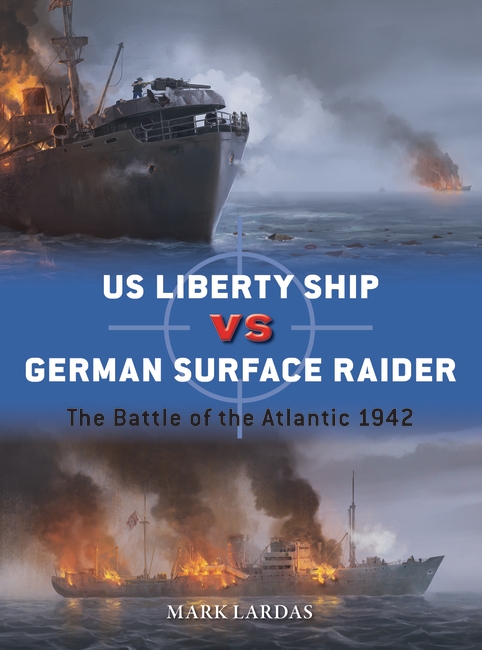
The German surface raiders – of both world wars – are among the most romanticized 20th-century warships. Sent out alone, disguised as an ordinary merchantman to hunt down enemy shipping, they were a return to the sailing-era corsairs. Operating isolated for months, virtually every ship they sighted was a likely foe.
They seem like natural candidates for Osprey’s Duel series, fighting the foe one-on-one. In 2010 Osprey published one: German Commerce Raider vs British Cruiser. Its focus was on battles between German raiders and British cruisers in 1941.
The main objective of the raiders were not warships. The German raiders helmed by competent captains avoided them. Only when circumstances came against them were they forced into battle. What they sought were merchantmen, the larger the better.
The battles between surface raiders and the merchant vessels they preyed upon involved one-on-one combat, the focus of the Duel series. The battles were high drama – David against Goliath. A high-stakes battle for both sides ensued; an outgunned merchantman facing down an enemy that cannot afford to take much damage.
There is one problem with a Duel between merchant ships and surface raiders. There must be battles between the combatants, both sides shooting and a chance for victory for both sides. A Duel with all the battles ending as the equivalent of Godzilla fighting Bambi would be dull reading. There was little incentive for either the merchantman or the raider to slug it out.
The raider wanted to avoid prolonged combat. It wasted ammunition and risked damage that could rarely be repaired at sea. The raider preferred capturing a prize to sinking a ship without warning. A typical encounter had the raider finding a lone ship on an isolated sea lane, unmasking its hidden guns and demanding the ship stop.
The raider might fire one shot across the bow to emphasize its demand. It would fire into the radio room if the potential prize attempted to send a radioed warning, firing until transmission stopped. If the ship cooperated, stopped moving and maintained radio silence, the battle ended there.
The merchantman would be boarded and examined, its crew taken aboard the raider as prisoner. Useful supplies (diesel oil and food usually) were transferred to the raider and the ship sunk. Typically, this was achieved by opening seacocks to flood it. If the ship refused to sink, a torpedo might be fired to hasten it to the sea bottom.
Merchant mariners, even officers, were not paid to die for their country. They were civilians, at sea to earn a living. Often, they were not even on a ship flying the flag of their country. They wanted to go from port to port and collect their pay at the voyage’s end. Fighting a heavily armed warship was not in the job description.
If a raider appeared, most captains were content to send out the “QQQ” signal (Am being attacked by a disguised raider), and their position. Then they had the radio operator shut down once the raider started firing at them. Fighting back got you dead.
That described most the battles between raiders and merchantmen during the first wave of raiders, sailing between 1940 and 1941. A few skippers tried to escape. In most cases the battles ended with little drama. Not much for a Duel author.
Then, just as the second wave of raiders was ready to set out in 1942, the United States entered the war. It was a humiliating entry, with the US fleet at Pearl Harbor devastated by a Japanese sneak attack.
Americans are pugnacious, ready to fight. They had a long tradition of being willing to fight against long odds. The Alamo, Little Round Top, and the Little Big Horn are part of the American mystique. They were never more ready to fight against long odds than in 1942. Even when it made more sense to yield. Even its merchant mariners.
This is not to say the merchant marine of other nations would not fight. Of the British ships attacked by surface raiders, around one-third resisted. (One successfully outran a German raider.) Three-quarters of the US ships attacked fought back. Those which did fight continued fighting until the ship sank or exploded out from under them.
This includes the battle at the heart of US Liberty Ship vs German Surface Raider, between the Kriegsmarine auxiliary cruiser Stier and the Liberty Ship Stephen Hopkins. At its end both ships were so badly damaged they sank.
There were other notable confrontations between raiders and US merchant ships. These included fights between Stier with Stanvac Calcutta and Michel with William F Humphrey. Although neither merchant ship was successful, their battles were interesting. So was Michel’s attack on George Clymer. That was one of the most curious fights of the war, both in terms of the actual battle and its aftermath.
The clashes between US merchantmen and German raiders provided enough material for a really interesting Duel. All it took were a few ships whose captains and crews were prepared to disregard the accepted customs of marine warfare and were crazy enough to fight, regardless of the odds against them. US Liberty Ship vs German Surface Raider is the result.

Captain Horst Gerlach commanded Stier

Jerimiah O'Brien is one of last surviving Liberty Ships

SS Stephen Hopkins at Launch

Stier Burning after the Battle with Stephen Hopkins
Comments
You must be logged in to comment on this post. Click here to log in.
Submit your comment