
Having been born in 1955, I grew up surrounded by the then recent history of World War II. My father had served in the US Navy during the war, in the Atlantic, Mediterranean, and finally the Pacific. Many of his contemporaries had served during the war. I developed an early interest in the naval war, an interest that expanded to encompass all of the war and all theaters. The Pacific campaigns became a subject of particular interest. While growing up I was lucky that my local public library had a solid history section. At the early age of ten years I began reading Samuel Elliot Morrison’s 15-volume History of United States Navy Operations in World War Two, being very interested in the naval war in which my father served. For reasons still unknown, I became fascinated by Morison’s Volumes XII Leyte and Volume XIII, Liberation of the Philippines. After devouring these I located and read the US Army’s Official History volumes Leyte and Triumph in the Philippines. These four books resulted in a deep interest in the 1944–45 Philippines Campaign.
The liberation of the Philippines was the largest American campaign of the war against Japan. The naval side of the campaign saw the evisceration of the Imperial Japanese Navy during the Battle of Leyte Gulf, aerial operations saw the introduction of the Japanese Kamikaze tactic, and land battles that found US Army units engaging and defeating Imperial Japanese Army (IJA) troops that ranged from crack regulars to hastily improvised forces. This plethora of Japanese ground combat units, and their performance in combat against the US Army make for an interesting subject. The ability of the Japanese to build combat units from replacements, returning wounded, non-combat service troops, aviation ground echelon units, and construction troops was amazing. By studying three actions during the 1944–45 Philippines Campaign in Combat 85 I hope to provide readers some insights into the problems and difficulties of land combat in the mid-20th century.
I also want to raise awareness about errors regarding the organizations, strengths, and equipment of IJA units on Pacific battlefields in earlier popular works. I do not think these errors were deliberate. Instead these have resulted from using information published in wartime intelligence manuals about the IJA. Being wartime publications they were subject to mistakes. Few people understood during the war that IJA units, such as the 1st Division, encountered by US forces on Leyte, were sent into combat with major alterations made to their official “paper” structure, strength and equipment. The IJA made these changes because it thought they made units more suitable for their intended location and operation. Actually, IJA units sent to fight in the Pacific usually had their structure and equipment allocations modified from the very beginning of the war. Americans frequently found, and continue to find, these changes confusing. This is accentuated by the American efforts to create uniformly organized and equipped units. At the beginning of its description of infantry divisions the 1944 edition of American Intelligence’s The Handbook of Japanese Military Forces lists four types of divisions: standard, strengthened, strengthened (modified), and special (two brigades). However, these types of divisions and their accompanying tables of organization and equipment did not match the actual organization and equipment of the 1st Division on Leyte, the 39th Regiment on Luzon, or the improvised Kawashima Force also on Luzon, all of which feature in Combat 85.
For Combat 85’s three actions I chose one encounter on Leyte and two on Luzon. On Leyte it seemed that the Battle of Breakneck Ridge offered the best case to study. Here, prewar Japanese and American regular divisions fought each other. The Japanese unit involved was the 1st Division, a highly regarded prewar unit, which, however, had not seen significant combat experience since the Russo-Japanese War. The 1st Division went into battle expecting to attack and drive Americans into the Leyte valley as part of a general counterattack by the IJA’s 35th Army to destroy the US 6th Army. Immediately upon encountering the Americans the 1st Division was thrown upon the defensive by the attacking US 24th Infantry Division. The 24th Division was the prewar Hawaiian Division of the Regular Army. Profiling the 1st Division gave the opportunity to show how the IJA’s published organization tables that are frequently cited by authors, and published during the war by American Intelligence for reference, were seldom, if ever, actually used in the Pacific. Those tables gave the 1st Division a strength of over 20,000 men, but this was for the division if it was fighting in Manchuria against the Soviet Union. When deployed to the Pacific the 1st Division, as were all others, drastically reduced in manpower and horses. Much of the division’s extra manpower was associated with horse transport which was not suitable for use on tropical islands and thus were left behind.
The book’s second action is on Luzon and is the Battle of Zig Zag Pass. Here the IJA was represented by a detachment built around a prewar regular infantry regiment less one of it its battalions. This was the 39th Infantry Regiment of the 10th Division. The 39th Infantry had extensive combat experience in China from July 1937 to October 1939, at which time it was redeployed to Manchuria to face the Soviet Union. Before its 1944 movement to the Pacific front this regiment, and its parent division, were restructured like the 1st Division for tropical service. The primary American participants were serving in an inexperienced National Guard division. This division soon was in action amid difficult jungle terrain against the veteran 39th Regiment. In this first major fight the green 38th Division found itself recklessly pressed forward by an inexperienced corps commander.
The third action, the capture of the Ipo Dam (a key part of Manila City’s fresh water supply system), looks at an IJA provisional brigade, the Kawashima Force, made of a miscellaneous collection of air force, supply, and service troops with a single battalion of garrison troops attached and several batteries of regular artillery. Kawashima Force fought against another US National Guard division, the 43d. The 43d had extensive combat experience from fighting in the Solomons and on New Guinea. By 1945 it was a well-led veteran division which, reinforced by a regiment of determined Filipino guerrillas, smashed the Kawashima Force. The same corps commander from Zig Zag Pass was present, but this time stayed out of the division commander’s way and allowed him to run the battle. Americans reported many of the provisional Japanese units were tough and capable opponents when defending positions, but found they lacked basic infantry skills when attempting to attack. One contemporary American assessment claimed that provisional units were frequently more determined when defending positions than many normal IJA units.
The Pacific Campaigns of World War II were vast and complex. Many studies remain to be done that can range from strategic bombing, submarine actions, naval battles, aerial dogfights, and small infantry battles. Whenever I think of the Pacific, I always remember my father, and several of his friends, who endured and survived the war. These men did not boast of heroics. It seemed that the more combat they had seen, the less they were willing to talk about. When they spoke of the war their tales were about humorous and fun events that happened away from the fighting.
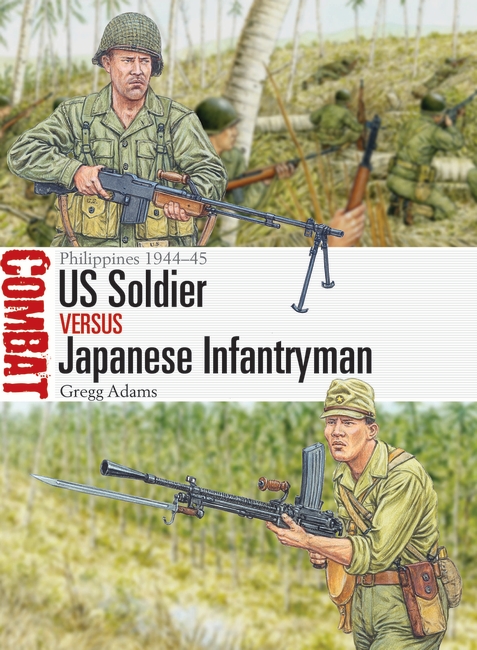
You can read more in CBT 85 US Soldier vs Japanese Infantryman: Philippines 1944–45.
Comments
You must be logged in to comment on this post. Click here to log in.
Submit your comment